Fine fog that drifts away instead of landing as droplets commonly indicates excessive pressure at spray nozzles. If only one head mists, inspect its nozzle for damage or debris. If an entire spray zone mists, measure pressure and consider correctly sized pressure-regulated spray bodies rather than closing random valves.
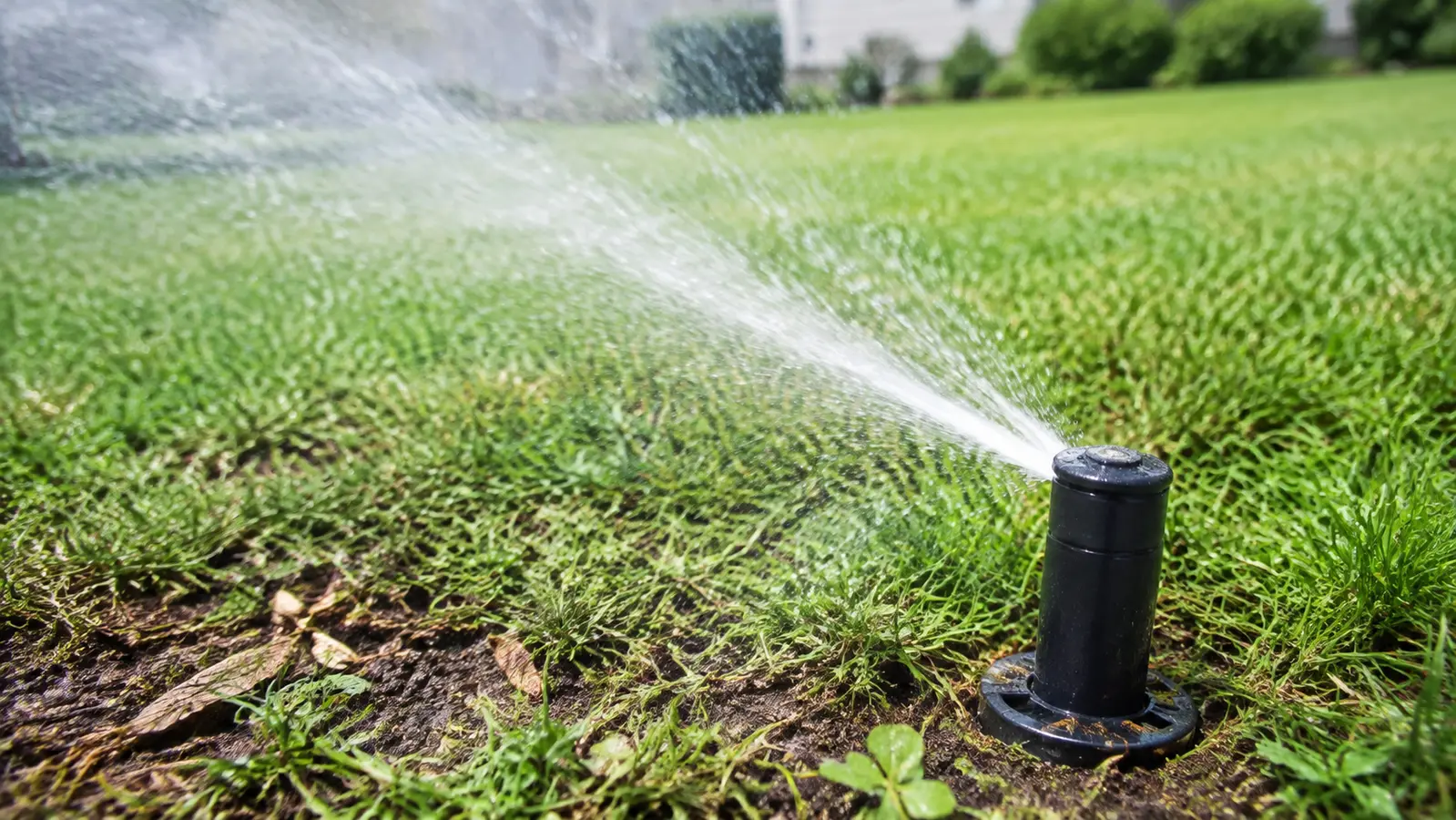
Tell true fogging from a local nozzle or wind problem
Inspect droplets close to the nozzle in calm air before changing pressure or buying regulated bodies.
| Pattern | Best explanation | Best next test |
|---|---|---|
| One head mists | Damaged, dirty, wrong, or nearly closed nozzle | Clean and compare exact nozzle model |
| Whole spray zone mists | Excess dynamic pressure | Measure while the zone runs |
| Normal droplets drift sideways | Wind | Repeat in a calm window |
| Fog worsens when heads are capped | Pressure rises as demand falls | Restore matched demand; test regulation |
Use this boundary: About 30 psi is common for fixed sprays, not a universal target for rotary nozzles or rotors.
Use the nozzle family—not one universal PSI target
Fine droplets at the nozzle in calm air can indicate excessive pressure, but fixed sprays and rotary nozzles do not share the same target.
| Published evidence | Documented value or condition | Decision |
|---|---|---|
| EPA WaterSense | Pressure above the nozzle optimum can cause misting, fogging, excess flow, and uneven coverage | Measure dynamic pressure before adding runtime |
| Hunter Pro-Spray PRS30 | Regulates to 30 PSI | A fixed-spray example; not a target for every rotor or rotary nozzle |
| Hunter Pro-Spray PRS40 | Regulates to 40 PSI | A rotary-nozzle example where 30 PSI may reduce intended radius |
| Rain Bird 1800 PRS | 30 PSI for spray nozzles; 45 PSI for rotary nozzles | Match body regulation to the installed nozzle family |
| Hunter pressure relationship | About 20% pressure change produces about 10% flow variation | Small pressure changes matter most on low-pressure devices |
What the sample changes: Confirm true fogging close to the nozzle in calm air, identify the nozzle family, then compare measured dynamic pressure with that product chart. Wind drift and one damaged nozzle are different repairs.
EPA and manufacturer product pages were reviewed August 30, 2026. PSI values remain tied to named products; they are examples, not a universal residential irrigation specification.Match the pattern before opening anything
| Possible cause | Best clue | First check |
|---|---|---|
| Excessive spray-head pressure | Most heads create airborne fog | Compare pressure with nozzle specifications |
| Damaged or wrong nozzle | Only one head mists | Inspect the nozzle opening and model |
| Debris or partial obstruction | Pattern is distorted as well as fine | Clean nozzle and screen |
| Wind | Droplets form normally but drift sideways | Observe during calm conditions |
Read the system before replacing a part
Use the observation that most closely matches your yard. Each row changes the next test, so you do not spend an afternoon proving the wrong theory.
What it meansZone pressure is likely above the spray/nozzle design range.
Do nextMeasure dynamic pressure and verify the exact nozzle chart.
What it meansIts nozzle is damaged, dirty, mismatched, or adjusted nearly closed.
Do nextInspect nozzle and screen before changing zone pressure.
What it meansWind—not necessarily pressure—is moving the water.
Do nextRepeat during a calm window before modifying hardware.
What it meansReduced zone demand is raising pressure at the remaining sprays.
Do nextRestore matched nozzles and use purpose-built pressure regulation.
Four tests that narrow the fault
Stop as soon as one result gives you a clear boundary. The goal is not to perform every test; it is to eliminate whole groups of causes safely.
- 01
Classify local or zone-wide misting
Observe at least three heads and include one nearest and one farthest from the valve.
IF YES / NORMALOne abnormal head receives a nozzle-level repair.
IF NO / ABNORMALSimilar fog zone-wide justifies a dynamic-pressure check.
- 02
Repeat in calm air
Run briefly early in the day and inspect droplet formation within a foot of the nozzle.
IF YES / NORMALLarge droplets near the head indicate wind drift rather than true fogging.
IF NO / ABNORMALFine droplets at the source support pressure or nozzle trouble.
- 03
Measure at operating flow
Use an appropriate irrigation pressure gauge or professional test while the zone runs; static house pressure alone is not nozzle pressure.
IF YES / NORMALMeasured pressure matches the exact nozzle/body specification.
IF NO / ABNORMALExcess pressure supports a correctly selected regulator or regulated body.
- 04
Verify one corrected head before a zone conversion
Clean or replace the exact nozzle, or test the manufacturer-matched pressure-regulated body on one representative location.
IF YES / NORMALDroplet size and catch distribution improve without shrinking required throw.
IF NO / ABNORMALRecheck demand, valve behavior, and mixed nozzle families before replacing every body.
Numbers worth measuring
Not universal; rotary nozzles and rotors can require different operating pressure.
Use only as a product-specific example, not a whole-system target.
Common fixes that waste time
It can create unstable flow and is not calibrated regulation at the head.
Longer fogging increases evaporation and drift rather than improving distribution.
Each nozzle family has its own pressure and precipitation characteristics.
How the evidence changes the repair
A whole spray zone produced visible fog while the adjacent rotary zone did not.
- Fog formed at the nozzle even during calm conditions.
- The zone's operating pressure exceeded the fixed-spray nozzle specification.
- One compatible 30-psi regulated body produced larger droplets and maintained required radius.
The one-head trial proved a pressure/nozzle match before converting the zone. Runtime was left unchanged until a catch test verified distribution.
How to confirm the repair actually held
A single successful start can hide an intermittent splice, sticky valve, remaining leak, or scheduling problem. Recreate the original conditions before calling the job finished.
Pass: Water leaves as usable droplets with no zone-wide fog.
If not: Pressure or nozzle matching remains wrong.
Pass: Low readings improve without losing required throw.
If not: The visible spray improvement did not improve distribution.
Pass: Every changed head matches the manufacturer's operating specification.
If not: Do not convert the rest of the zone yet.
Check these in order
- 01
Check whether misting is zone-wide
One fogging head points to a local nozzle. Similar fog at every spray head points toward excessive pressure or an incompatible nozzle/body combination.
- 02
Observe in calm weather
Wind can make a normal fine spray look like misting. Test briefly during a calm period and look at droplet formation close to the nozzle.
- 03
Clean and identify the nozzle
Rinse the screen and confirm the nozzle radius, arc, and recommended pressure. Do not enlarge an opening with a pin or mix a high-flow nozzle into a matched zone.
- 04
Measure instead of throttling blindly
Pressure should be compared with the manufacturer's nozzle specification. Partially closing an unrelated supply valve can create unstable flow and is not a substitute for correct regulation.
- 05
Use purpose-built regulation
Pressure-regulated spray bodies maintain a specified pressure at each head and can reduce fogging and uneven distribution when correctly selected for the nozzle family.
- Static or dynamic pressure measurement is required.
- The zone needs a regulator or pressure-regulated body conversion.
- Misting occurs with water hammer, pipe noise, or unstable house pressure.
What homeowners ask about this symptom
What pressure stops sprinkler misting?
There is no universal value. Many standard spray nozzles are designed around 30 psi, while other nozzle families differ. Use the exact manufacturer's operating range.
Does misting mean the pressure is too low?
Usually zone-wide fogging points to pressure that is too high at spray nozzles. Low pressure more often produces short reach, poor pop-up, and heavy uneven streams.
Sources and review notes
General maintenance logic is checked against EPA WaterSense outdoor irrigation guidance. Product controls and disassembly steps vary by model; use the current manufacturer manual for your exact valve, controller, or sprinkler head.