Dry spots do not always mean the zone needs more run time. First check head alignment, blocked spray, nozzle match, pressure, and head-to-head coverage. If water is already pooling elsewhere, longer watering will deepen the imbalance instead of correcting distribution.
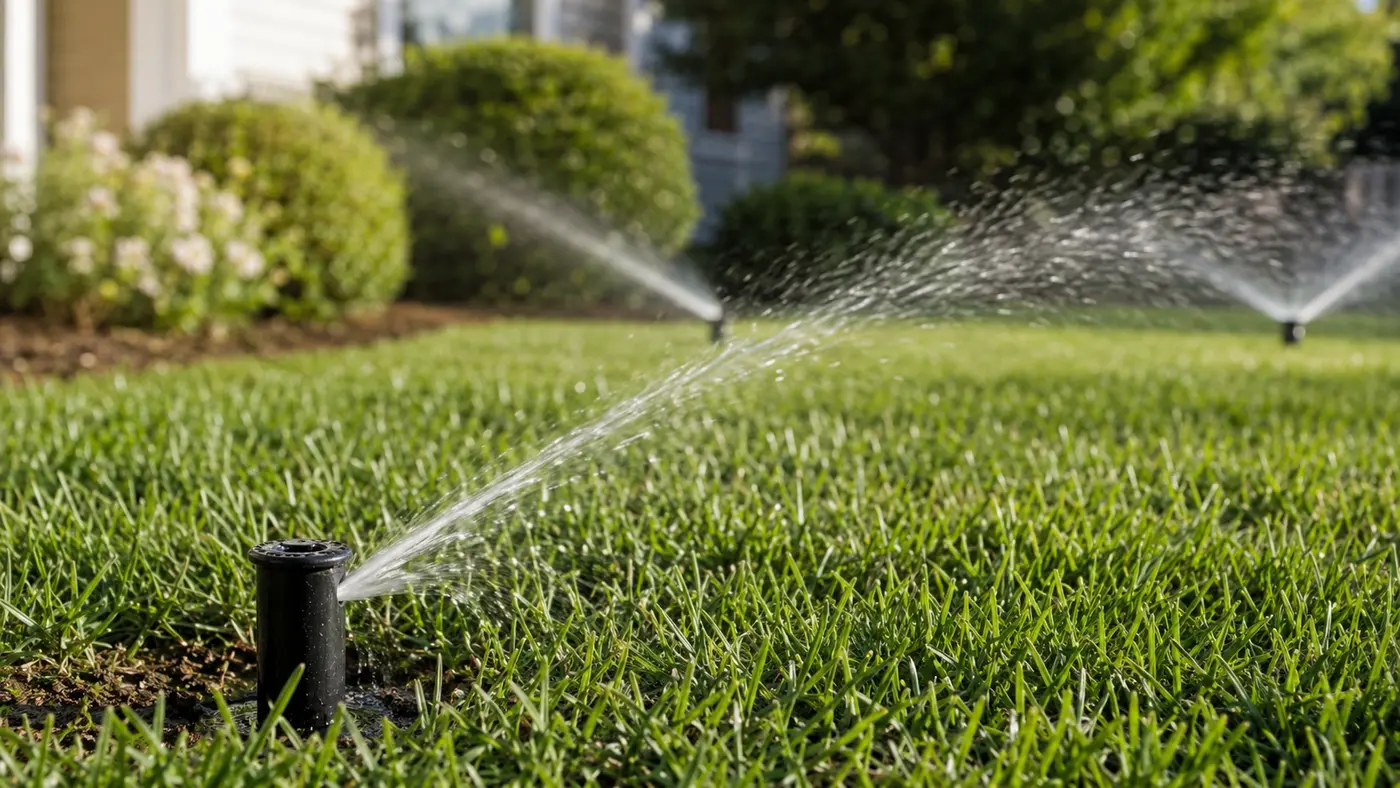
Average depth and uniformity answer different questions
A zone can apply enough water on average while leaving one quarter chronically dry. Use the calculator below instead of judging the spray by eye.
| Result | Meaning | Corrective direction |
|---|---|---|
| All cans similarly low | Even distribution, insufficient applied depth | Adjust runtime after checking precipitation rate |
| Average adequate; low quarter poor | Water is distributed unevenly | Fix overlap, arc, radius, obstruction, or nozzle matching |
| One wedge is low | Local head/nozzle/obstruction | Inspect the head that begins the wedge |
| Wet and dry bands repeat | Mixed precipitation or spacing problem | Match nozzle families and head-to-head coverage |
Use this boundary: Fix distribution before adding runtime; extra minutes multiply both the dry shortage and wet-area excess.
Read average depth and the driest quarter separately
A zone can apply enough water on average while its driest quarter remains far below target. The catch-can calculator turns that hidden imbalance into a number.
| Evidence | Published calculation or example | Decision |
|---|---|---|
| Low-quarter DU | Average of the lowest 25% ÷ average of all cans × 100 | Use the dry end of the pattern, not one dramatic cup or the average alone |
| NMSU fixed-spray rating | 0.75 excellent; 0.65 very good; 0.55 good; 0.50 fair; 0.40 poor | A low result justifies correcting distribution before runtime |
| NMSU rotor rating | 0.80 excellent; 0.70 very good; 0.65 good; 0.60 fair; 0.50 poor | Do not judge rotors with a fixed-spray benchmark |
| Hunter matched-precipitation example | Same radius: 360° 4 GPM, 180° 2 GPM, 90° 1 GPM | Equal nozzle flow at unequal arcs creates systematic wet corners |
| Head-to-head coverage | Rain Bird directs changing to a nozzle that reaches the next head when overlap is absent | Correct radius/spacing before increasing minutes |
| Pressure regulation | EPA links optimal nozzle pressure to more uniform distribution | A zone-wide pressure problem can distort an otherwise correct layout |
What the sample changes: Fix the pattern when low-quarter DU is weak; adjust runtime only after distribution is acceptable. More minutes cannot repair missing overlap or mismatched precipitation.
Extension, EPA, and manufacturer references were reviewed August 30, 2026. The page calculator uses eight equal-size inputs; for a formal audit, follow the cited placement and sampling guidance with more catch cans.Calculate low-quarter distribution uniformity
Enter the collected depth from eight identical cans after one timed zone run. Any consistent unit works—use inches or millimeters, but do not mix them.
Distribution is usable but uneven. Correct the lowest locations before adding runtime.
Match the pattern before opening anything
| Possible cause | Best clue | First check |
|---|---|---|
| Blocked or misdirected spray | Dry wedge sits behind plants or a tilted head | Clear obstruction and level the head |
| Mismatched nozzle flow | Quarter, half, and full patterns apply different depths | Check matched precipitation family |
| Low pressure or leak | Dry area is at the far end of the zone | Compare head reach and inspect for wet soil |
| Poor spacing or runoff | Gap persists despite normal spray, or slopes shed water | Run a catch-cup and cycle-and-soak test |
Read the system before replacing a part
Use the observation that most closely matches your yard. Each row changes the next test, so you do not spend an afternoon proving the wrong theory.
What it meansSpacing, arc, radius, or head-to-head overlap is weak.
Do nextMap throw boundaries before adding runtime.
What it meansA clogged nozzle, wrong arc, tilt, or obstruction is likely.
Do nextInspect that head and its immediate neighbor.
What it meansRuntime or precipitation rate may be insufficient, but distribution can still be even.
Do nextSeparate average depth from uniformity.
What it meansLonger runtime will overwater wet areas before fixing dry ones.
Do nextCorrect distribution first.
Four tests that narrow the fault
Stop as soon as one result gives you a clear boundary. The goal is not to perform every test; it is to eliminate whole groups of causes safely.
- 01
Draw a coverage map
Mark every head, arc direction, obvious obstruction, and dry boundary while the zone runs briefly.
IF YES / NORMALThe geometry reveals missing overlap or one malformed pattern.
IF NO / ABNORMALIf geometry looks sound, measure distribution rather than guessing.
- 02
Run a repeatable catch-can test
Place identical straight-sided containers across wet, average, and dry areas; run one zone for the same measured time.
IF YES / NORMALSimilar depths point beyond irrigation toward soil, shade, roots, or turf health.
IF NO / ABNORMALLow containers identify the hydraulic or geometry gap.
- 03
Check head-to-head reach
Under calm conditions, see whether each stream reaches the neighboring head location.
IF YES / NORMALOverlap is present; inspect nozzle matching and obstruction.
IF NO / ABNORMALRestore radius, pressure, alignment, or layout before adding minutes.
- 04
Compare nozzle families and arcs
Record model, nozzle, arc, and rated flow for adjacent heads.
IF YES / NORMALMatched precipitation makes their applied depth comparable.
IF NO / ABNORMALMixed spray and rotary rates or mismatched arcs can create systematic dry and wet bands.
Numbers worth measuring
A median resists one spilled or anomalous can; repeat the same layout after adjustment.
Common fixes that waste time
More time multiplies both the dry shortage and the wet-area excess.
A pretty arc does not prove equal water reached the soil.
Different application rates can make uniform scheduling impossible.
How the evidence changes the repair
A crescent-shaped dry patch persisted although the zone looked visually active.
- Catch cans in the crescent collected about half the zone median.
- The nearest rotor stopped short of the next head after a radius adjustment.
- Restoring overlap raised the low-can readings without increasing runtime.
The catch-can pattern proved a distribution gap, not thirsty soil. Correcting radius solved the shortage without doubling water on the rest of the lawn.
How to confirm the repair actually held
A single successful start can hide an intermittent splice, sticky valve, remaining leak, or scheduling problem. Recreate the original conditions before calling the job finished.
Pass: Low readings move closer to the zone median without creating runoff.
If not: Adjustment changed appearance but not distribution.
Pass: Head-to-head overlap covers the former gap.
If not: Spacing, obstruction, or nozzle selection still limits coverage.
Pass: The dry boundary stops expanding while nearby areas avoid pooling.
If not: Check root-zone, soil, shade, or turf-health causes before adding runtime.
Check these in order
- 01
Watch one complete zone cycle
Look for blocked arcs, heads watering pavement, tilted bodies, short radius, misting, and streams that do not reach neighboring heads.
- 02
Check nozzle identity
Record radius and arc markings. Heads in one zone should be hydraulically compatible; mixing unmatched spray and rotor precipitation rates creates uneven application.
- 03
Run a catch-cup test
Place identical straight-sided cups across the area, run a measured interval, and compare collected depth. This shows distribution rather than relying on lawn color alone.
- 04
Correct hardware before runtime
Clean nozzles, level heads, restore intended arcs, and repair pressure or leak problems. Then adjust runtime based on measured application and local watering rules.
- 05
Use cycles for slow-infiltration areas
If water begins to run off before the target depth is applied, split watering into shorter cycles separated by soak time rather than extending one continuous run.
- The original design lacks head-to-head coverage.
- The zone mixes incompatible head types and needs redesign.
- Local watering restrictions or slope runoff require a site-specific schedule.
What homeowners ask about this symptom
Should I water longer to fix a dry spot?
Only after correcting distribution. Longer runtime can overwater the areas already receiving enough water while the poorly covered spot remains dry.
Can different nozzles share one zone?
They can when their precipitation rates and pressure requirements are deliberately matched. Randomly mixing spray and rotor nozzles often creates uneven depth.
Sources and review notes
General maintenance logic is checked against EPA WaterSense outdoor irrigation guidance. Product controls and disassembly steps vary by model; use the current manufacturer manual for your exact valve, controller, or sprinkler head.