Regional 2026 pages combine controller repair and replacement at roughly $105–$570. Homewyse lists $155–$329 for favorable-condition smart-controller installation before hardware. Current manufacturer examples span about $60 for an entry 8-zone Orbit to $250 for a 16-zone Rachio, before enclosure, modules, wiring repair, Wi-Fi setup, programming, and testing. Compare complete scopes—not a quote against the cheapest shelf box.
Hardware price is only the first line
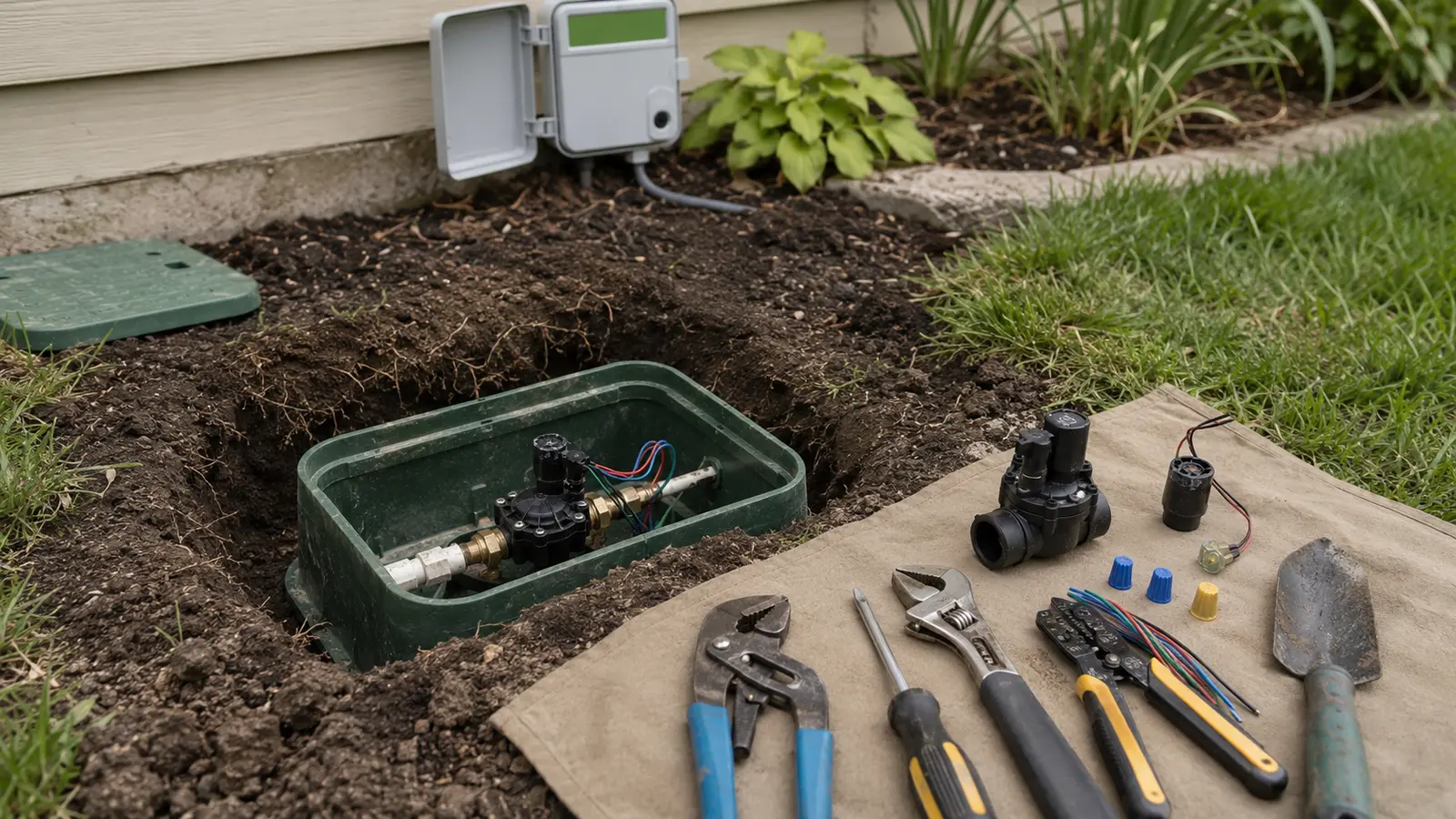
A fair quote separates the controller from enclosure, modules, power, wiring cleanup, Wi-Fi commissioning, schedules, sensors, and field faults.
| Scenario | Planning range | Included assumptions |
|---|---|---|
| Basic like-for-like installation labor | $155–$329 before hardware in Homewyse 2026 | Existing outlet, wiring, and favorable access |
| Common 4–8 station hardware | Roughly $50–$200 retail | Conventional or entry smart controller |
| 12–16 station/smart hardware | Roughly $150–$350+ retail | Modules, outdoor enclosure, brand/features vary |
| Professional smart upgrade | $350–$900 commonly seen | Hardware, mounting, Wi-Fi, setup, testing |
Use this boundary: If only one station fails, prove the terminal, cable, splice, and solenoid before buying a whole controller.
Separate controller hardware from repair and commissioning
Regional cost pages often combine controller repair and replacement. Manufacturer prices below isolate the hardware; Homewyse isolates a favorable-condition installation estimate.
| Market / item | Published range or price | What it includes |
|---|---|---|
| Homewyse national estimate | $155–$329 | Smart-controller installation estimate before hardware |
| Phoenix, AZ — Angi | $105–$520 | Controller repair or replacement |
| Dallas, TX — Angi | $105–$520 | Controller repair or replacement |
| Denver, CO — Angi | $110–$530 | Controller repair or replacement |
| Tampa, FL — Angi | $105–$505 | Controller repair or replacement |
| Los Angeles, CA — Angi | $115–$570 | Controller repair or replacement |
| Orbit B-hyve indoor, 8-zone | $59.99 observed collection price | Controller hardware only; price can change |
| Orbit B-hyve XR indoor/outdoor | $169.99 | Controller hardware only |
| Rachio 3 | $199.99 8-zone; $249.99 16-zone | Indoor controller hardware; outdoor enclosure separate |
| Rachio weatherproof enclosure | $39.99 | Outdoor housing accessory, not installation |
What the sample changes: The quote should show hardware, enclosure, modules, power, field-fault repair, app setup, schedule transfer, sensor integration, testing, and homeowner handoff as separate scope decisions.
Seven installation/repair ranges and current manufacturer prices were checked August 30, 2026. Sale prices can change. The regional Angi rows share one publisher methodology and are not treated as contractor bids.Match the pattern before opening anything
| Possible cause | Best clue | First check |
|---|---|---|
| Like-for-like basic replacement | Existing power, enclosure, and labeled zone wires are reusable | Match station count and transformer requirements |
| Smart-controller upgrade | Wi-Fi, weather logic, app setup, and account transfer are requested | Confirm signal, compatibility, and ongoing app needs |
| Modular or high-zone system | Expansion modules, master valve, pump relay, or two-wire paths exist | Document every terminal before pricing |
| Field fault mistaken for controller failure | Only one station or one wet splice fails | Compare output with a working station |
Read the system before replacing a part
Use the observation that most closely matches your yard. Each row changes the next test, so you do not spend an afternoon proving the wrong theory.
What it meansA like-for-like swap has a predictable lower labor scope.
Do nextMatch transformer, enclosure, and sensor compatibility.
What it meansAccount setup, signal, schedules, and homeowner handoff add labor.
Do nextPrice hardware and configuration separately.
What it meansThe visible timer is only one part of a more complex control system.
Do nextMap every terminal and supported accessory.
What it meansA field circuit is more likely than total controller failure.
Do nextCompare the station output with a known-good station.
Four tests that narrow the fault
Stop as soon as one result gives you a clear boundary. The goal is not to perform every test; it is to eliminate whole groups of causes safely.
- 01
Prove the controller is the boundary
Check outlet or transformer, display stability, one good station, failed output, and field load before replacement.
IF YES / NORMALThe controller or required module is the remaining failed boundary.
IF NO / ABNORMALRepair power, wire, splice, sensor, or solenoid first.
- 02
Build a complete I/O inventory
Count stations, common wires, master valve, pump relay, rain or flow sensors, modules, and future spare capacity.
IF YES / NORMALCandidate hardware supports the whole system.
IF NO / ABNORMALA cheap base timer may require modules or lose existing functions.
- 03
Separate install from commissioning
List removal, mounting, enclosure, wiring labels, app account, Wi-Fi, sensor setup, program transfer, zone naming, and training.
IF YES / NORMALThe price explains what happens after wires are connected.
IF NO / ABNORMALUnpriced setup can leave a powered controller that is not ready to water.
- 04
Run every output and one schedule
Test each station, shared devices, sensors, automatic start, app alert, and manual local control.
IF YES / NORMALThe replacement operates hydraulically and logically.
IF NO / ABNORMALField faults or setup gaps must be corrected before sign-off.
Numbers worth measuring
Observed manufacturer hardware examples run about $60–$250. Enclosure, modules, field repair, pumps, commissioning, and regional labor are additional scope.
Common fixes that waste time
Hardware does not include diagnosis, enclosure, wiring cleanup, setup, programming, testing, or warranty.
The failed boundary may be a splice, cable, or solenoid outside the controller.
Software cannot repair leaks, pressure loss, clogged nozzles, or unmatched precipitation.
How the evidence changes the repair
A homeowner received a $950 smart-controller quote after one station stopped watering.
- Seven other stations operated normally.
- The failed terminal produced normal voltage.
- Voltage disappeared at a wet field splice near the valve.
The controller was functioning. Isolating the one field circuit converted a full upgrade quote into a wiring repair; a smart upgrade could then be evaluated as an optional feature, not an emergency fix.
How to confirm the repair actually held
A single successful start can hide an intermittent splice, sticky valve, remaining leak, or scheduling problem. Recreate the original conditions before calling the job finished.
Pass: All outputs, master valve or pump, and sensors behave correctly.
If not: Field faults or configuration gaps remain.
Pass: Clock, schedule, weather logic, and hardware agree.
If not: Commissioning is incomplete.
Pass: Labels, owner credentials, settings, and warranty information are handed over.
If not: Future service will begin with avoidable guesswork.
Check these in order
- 01
Prove replacement is necessary
Test the outlet or transformer, controller output, and one known-good field circuit. A tripped GFCI, failed transformer, shorted solenoid, or broken wire may be the real repair.
- 02
Count every required circuit
Include zones, common conductors, rain or flow sensor, master valve, pump relay, expansion modules, and spare capacity. The visible station count is not always the full scope.
- 03
Separate hardware from setup
Price controller, enclosure, modules, surge protection, wiring cleanup, mounting, Wi-Fi connection, account creation, schedule programming, and homeowner handoff.
- 04
Check rebate and subscription details
Some utilities offer rebates for WaterSense-labeled controllers. Confirm whether weather features require an account, paid service, or compatible sensors.
- 05
Demand a full functional test
The contractor should run every station, verify master-valve or pump behavior, test sensors, confirm automatic scheduling, and leave a wiring map.
- The controller is hardwired to mains power or shows heat, arcing, or water damage.
- A pump relay, high-voltage equipment, or complex master-valve circuit is involved.
- Several field shorts must be repaired before a new controller can be protected.
What homeowners ask about this symptom
Can I replace a sprinkler controller myself?
A plug-in low-voltage controller with labeled wires can be approachable, but hardwired power, pumps, damaged conductors, code requirements, or uncertain terminals call for professional work.
Is a smart sprinkler controller worth the extra cost?
It can be when weather-based scheduling, remote alerts, and water savings suit the property. It does not repair bad hydraulics, leaks, wiring, or mismatched nozzles.
Sources and review notes
General maintenance logic is checked against EPA WaterSense outdoor irrigation guidance. Product controls and disassembly steps vary by model; use the current manufacturer manual for your exact valve, controller, or sprinkler head.