Published 2025–2026 replacement-only examples run about $125–$300 for many accessible residential valves, while one DFW contractor reports $275–$550 and national complex-job guidance reaches $300–$400+. Combined repair/replacement ranges in six sampled markets run roughly $75–$345. Do not average those unlike scopes: identify rebuild versus replacement, then separate diagnosis, access, plumbing, wiring, restoration, warranty, and tax.
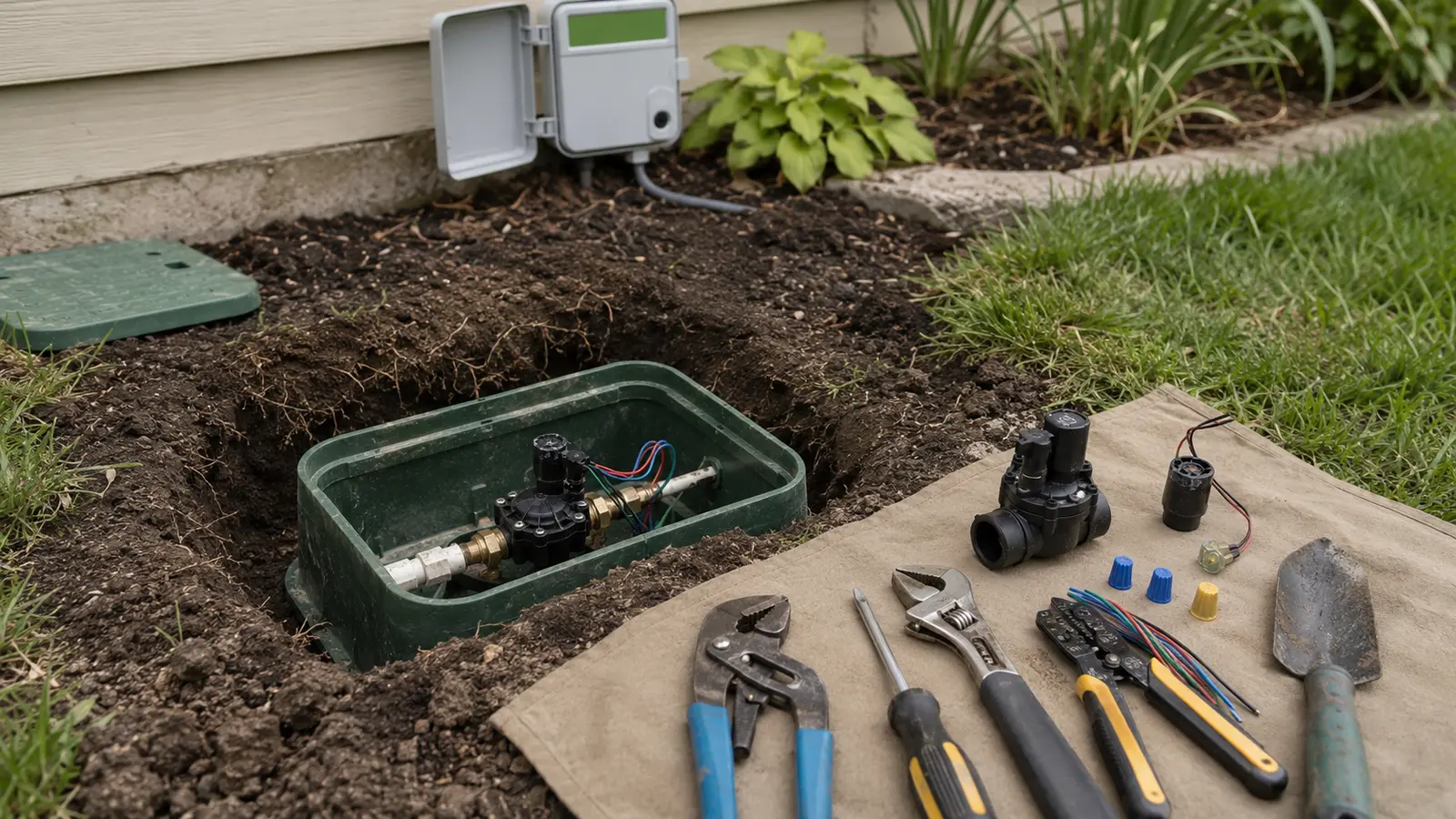
Compare the same repair scope
Published U.S. prices vary because one quote may include diagnosis and excavation while another prices only the valve swap.
| Scope | Planning range | What changes it |
|---|---|---|
| Solenoid/internal-part service | $100–$250 typical planning range | Model, service-call minimum, wiring repair |
| Accessible single valve replacement | $125–$300 commonly published/quoted | Regional labor, pipe size, box condition |
| Buried/crowded valve or manifold work | $300–$600+ | Locating, roots, brittle fittings, reconstruction |
| Multiple-valve manifold rebuild | Project quote required | Shared access may reduce per-valve labor |
Use this boundary: Ranges are planning data, not a bid. Require diagnosis, parts, excavation, wiring, testing, restoration, warranty, and tax to be listed.
What published valve prices look like across U.S. markets
These are separate published ranges, not numbers blended into a fake national average. Some sources combine repair and replacement; replacement-only sources are marked so you can compare the right scope.
| Market / source | Published range | Scope |
|---|---|---|
| National — HomeGuide | $125–$225; $300–$400+ complex | Single-valve replacement; access difficulty separated |
| National — LawnLove | $69–$371 | Valve replacement; reported parts $10–$141 |
| Phoenix, AZ — Angi | $80–$310 | Valve repair or replacement |
| Dallas–Fort Worth — On Point | $100–$250 rebuild; $275–$550 replacement | Contractor-published local scope |
| Denver, CO — Angi | $80–$320 | Valve repair or replacement |
| Tampa, FL — Angi | $80–$305 | Valve repair or replacement |
| Los Angeles, CA — Angi | $90–$345 | Valve repair or replacement |
| San Diego, CA — Bloom Pro | $140–$300 | Full valve replacement |
| Cape Coral, FL — Outdoor Life Pros | $75–$200 typical; $215–$371 high | Failed valve per zone |
| Metro Detroit — Elite Sprinkler Systems | $150–$200 rebuild; $225–$300 replacement | 2026 contractor-published local scope |
What the sample changes: A fair quote cannot be judged from the valve price alone. First classify rebuild versus replacement, then add locating, excavation, manifold work, wiring, restoration, warranty, and tax.
Ten published ranges were recorded on August 30, 2026. They are a transparent convenience sample, not statistically representative bids. No values were invented, averaged, or presented as prices charged by Sprinkler Fix Lab.Match the pattern before opening anything
| Possible cause | Best clue | First check |
|---|---|---|
| Solenoid-only repair | Valve body and diaphragm pass manual tests | Request coil, wiring, and labor as separate scope |
| Valve rebuild | Body is sound but diaphragm or internal seals fail | Confirm an exact model repair kit is available |
| Full valve replacement | Body is cracked, obsolete, or cannot seal after service | Ask whether manifold cutting and rewiring are included |
| Manifold reconstruction | Several crowded or brittle valves share damaged fittings | Price the assembly scope separately |
Read the system before replacing a part
Use the observation that most closely matches your yard. Each row changes the next test, so you do not spend an afternoon proving the wrong theory.
What it meansA straightforward replacement can stay near the lower published range.
Do nextConfirm isolation, fitting type, wiring, and test scope.
What it meansA matched component repair may avoid cutting the manifold.
Do nextCompare rebuild warranty with full replacement.
What it meansLocating, excavation, and reconstruction dominate labor.
Do nextRequest those line items separately.
What it meansThe quote may be solving age risk rather than proven failures.
Do nextAsk for station-by-station evidence and an alternate repair scope.
Four tests that narrow the fault
Stop as soon as one result gives you a clear boundary. The goal is not to perform every test; it is to eliminate whole groups of causes safely.
- 01
Prove the failed boundary
Compare manual valve response, controller output, leak point, and a known-good station.
IF YES / NORMALEvidence points to the valve body or matched internal part.
IF NO / ABNORMALFix wiring, supply, or controller faults before pricing a valve.
- 02
Classify rebuild versus replacement
Record body condition, model availability, seat damage, cracks, threads, and repair-kit support.
IF YES / NORMALThe chosen scope matches the actual failed component.
IF NO / ABNORMALAn obsolete or damaged body supports replacement rather than repeated parts.
- 03
Normalize quote scope
List diagnosis, locating, excavation, parts, fittings, connectors, labor, cleanup, restoration, tax, and warranty.
IF YES / NORMALCompeting totals cover the same work.
IF NO / ABNORMALA cheap part-only quote and a turnkey quote are not comparable.
- 04
Demand repeatable completion
Specify several starts and stops, leak inspection with valve open and closed, and box recheck before backfill.
IF YES / NORMALThe new or rebuilt valve opens, closes, and stays dry repeatedly.
IF NO / ABNORMALIntermittent wiring or a second manifold leak remains.
Numbers worth measuring
Do not blend rebuild, combined repair/replacement, and full replacement into one average. Access, valve size, manifold work, and minimum charges define the comparable scope.
Common fixes that waste time
The job includes diagnosis, isolation, pipe work, wiring, testing, restoration, overhead, and warranty.
A new hydraulic part cannot restore a missing electrical command.
Shared excavation can reduce unit cost, but age alone does not prove failure.
How the evidence changes the repair
A quote proposed a $420 full valve replacement for one station that worked from the bleed screw.
- The valve opened hydraulically and did not leak.
- No controller voltage reached the valve-box conductors.
- A corroded waterproof splice was found upstream.
The quote priced the visible component, not the failed boundary. Repairing the splice restored the station and eliminated an unnecessary valve replacement.
How to confirm the repair actually held
A single successful start can hide an intermittent splice, sticky valve, remaining leak, or scheduling problem. Recreate the original conditions before calling the job finished.
Pass: The valve opens and closes cleanly every time.
If not: An intermittent electrical or hydraulic fault remains.
Pass: No fitting, bonnet, solenoid, or splice leaks.
If not: Do not backfill until the first wet point is corrected.
Pass: Parts, access, wiring, testing, restoration, and warranty match.
If not: Resolve missing scope before sign-off.
Check these in order
- 01
Confirm the valve is the fault
Document controller output, manual valve response, leak location, and whether the symptom affects one zone. A buried wire break should not become a valve invoice.
- 02
Classify repair versus replacement
A matched diaphragm or solenoid can preserve a sound body. Cracks, distorted seats, severe thread damage, or obsolete parts support full replacement.
- 03
Price access separately
A clean valve box differs from a buried valve under roots, concrete edges, or a packed manifold. Ask how much of the quote is locating, excavation, and restoration.
- 04
Check what completion means
The quote should include wiring connections, pressure test, repeated starts and stops, leak check, box cleanup, and restoration—not merely installing a new part.
- 05
Compare identical scopes
One estimate may include diagnosis and restoration while another lists only the valve swap. Normalize scope before comparing totals.
- The valve is on a pressurized mainline or near a backflow assembly.
- The manifold is brittle, undocumented, or packed too tightly for safe cutting.
- The quote proposes several valves without station-by-station evidence.
What homeowners ask about this symptom
Why does a $20–$40 valve cost hundreds to replace?
The job price also covers diagnosis, travel, water isolation, excavation, cutting and fitting pipe, waterproof wiring, testing, cleanup, warranty, and business overhead.
Is it cheaper to replace several valves together?
Often, because locating, water isolation, setup, and excavation are shared. But functioning valves should not be replaced automatically without considering age, access, and manifold condition.
Sources and review notes
General maintenance logic is checked against EPA WaterSense outdoor irrigation guidance. Product controls and disassembly steps vary by model; use the current manufacturer manual for your exact valve, controller, or sprinkler head.