In the reviewed 2026 regional sample, published irrigation pipe-leak ranges cluster around $125–$455, while one Cape Coral contractor reports $150–$300 as typical and $370–$400 at the high end. Major, unknown, mainline, hardscape, or restoration-heavy work can exceed those figures. First prove whether the leak exists with all zones off or only when one named zone runs; that boundary controls the useful price comparison.
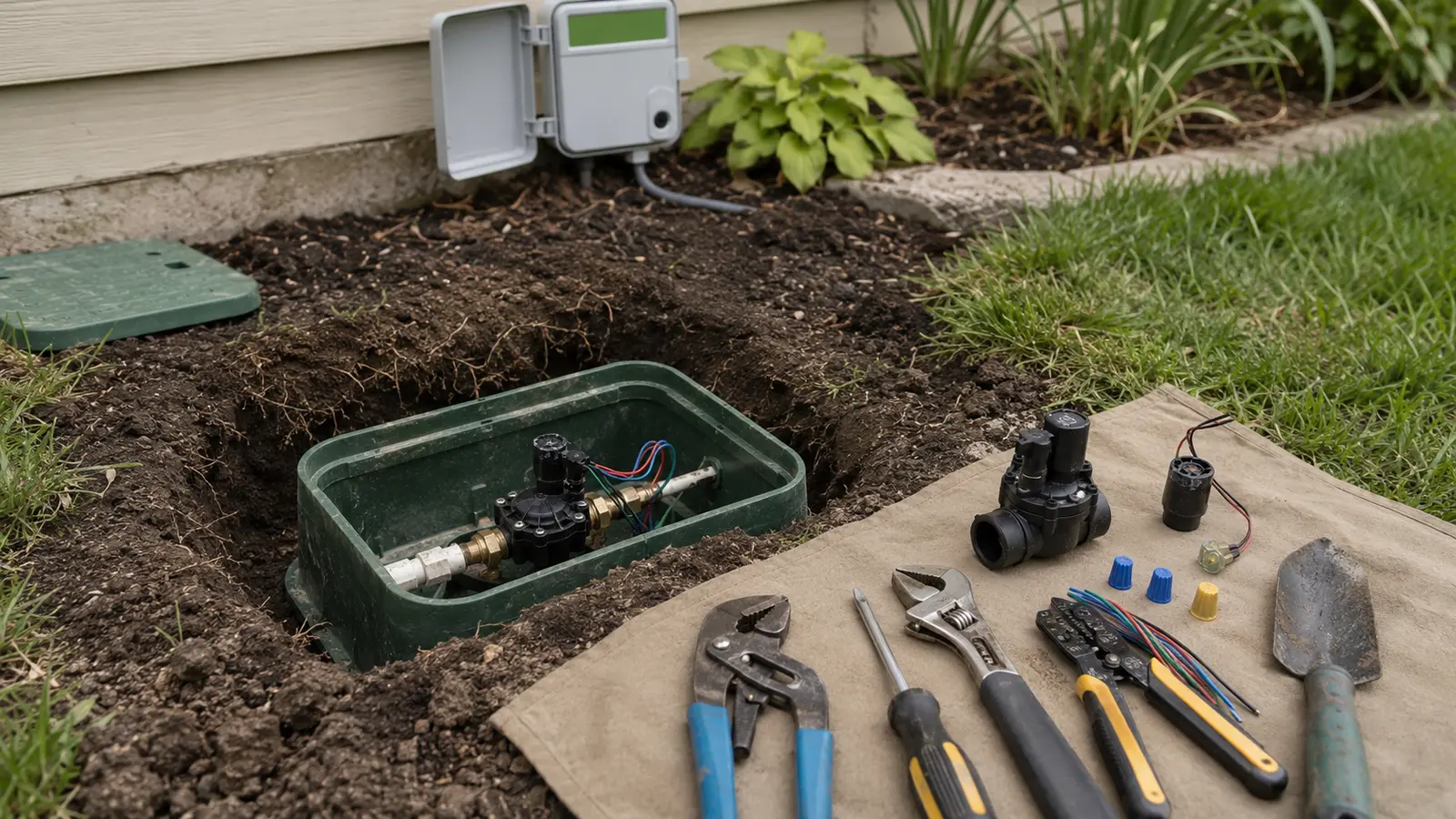
Price the leak boundary before pricing the hole
The fitting can cost a few dollars while locating, access, and restoration dominate the invoice.
| Leak boundary | Planning range | Major cost driver |
|---|---|---|
| Head/riser/local fitting | $100–$250 | Service minimum and access |
| Accessible lateral PVC/poly break | $150–$400 | Location confidence, depth, roots |
| Valve box/manifold leak | $200–$600+ | Crowding, brittle fittings, multiple valves |
| Mainline/unknown underground leak | $350–$800+ | Locating, continuous pressure, excavation |
| Under hardscape/large roots | Site-specific quote | Special access and surface restoration |
Use this boundary: Do not import ordinary domestic water-service replacement prices into a small irrigation lateral repair; the scope is different.
Published pipe-leak ranges across six U.S. markets
The numbers below are for irrigation pipe or underground leak work. They do not include every possible hardscape, foundation, utility, or domestic water-service repair.
| Market / source | Published range | Scope note |
|---|---|---|
| National — HomeGuide | $100–$400 typical; $600+ major | General irrigation repair; minor to major boundary |
| National — LawnStarter | $100–$490 in-ground repair | Broad in-ground system repair, not leak-only |
| Phoenix, AZ — Angi | $125–$415 | Underground or above-ground pipe leak repair |
| Dallas, TX — Angi | $125–$415 | Pipe leak repair |
| Denver, CO — Angi | $130–$425 | Pipe leak repair |
| Tampa, FL — Angi | $125–$405 | Pipe leak repair |
| Los Angeles, CA — Angi | $140–$455 | Locating and repairing an irrigation pipe leak |
| Cape Coral, FL — Outdoor Life Pros | $150–$300 typical; $370–$400 high | Underground PVC/poly leak |
| DFW — Better Earth | $100–$400+ | Leak repair; roots, depth, debris, and access drive scope |
What the sample changes: The useful number is not the widest national range. It is the range for the proven leak boundary plus locating, access, and restoration at that exact spot.
Nine published ranges were recorded on August 30, 2026. The regional Angi pages share one publisher methodology, so they show geographic adjustment—not nine independent contractor bids. The table keeps that limitation visible.Match the pattern before opening anything
| Possible cause | Best clue | First check |
|---|---|---|
| Head or riser leak | Water appears at one head only while its zone runs | Expose the local connection after shutdown |
| Lateral fitting or pipe break | One zone creates a wet patch and downstream heads weaken | Map last normal to first weak head |
| Valve or manifold leak | Water first appears inside a valve box | Dry the box and identify the first wet joint |
| Pressurized mainline leak | Water or meter movement continues with every zone off | Close the dedicated irrigation supply |
Read the system before replacing a part
Use the observation that most closely matches your yard. Each row changes the next test, so you do not spend an afternoon proving the wrong theory.
What it meansA head, riser, swing joint, or local fitting offers a small repair boundary.
Do nextExpose locally after shutdown.
What it meansA lateral pipe or fitting break needs focused locating and excavation.
Do nextMap last normal, first weak, and first wet point.
What it meansA mainline, manifold inlet, or non-closing valve may stay pressurized.
Do nextUse the dedicated shutoff and prioritize containment.
What it meansAccess and restoration can exceed the actual pipe-repair cost.
Do nextRequest separate locating, access, and restoration options.
Four tests that narrow the fault
Stop as soon as one result gives you a clear boundary. The goal is not to perform every test; it is to eliminate whole groups of causes safely.
- 01
Assign on-state or off-state
Dry the area and document water with all zones off, one zone active, and after shutdown.
IF YES / NORMALThe leak is assigned to pressurized side, one lateral, or drainage.
IF NO / ABNORMALExclude rain, groundwater, and non-irrigation sources.
- 02
Create the smallest search boundary
Combine first wet point, head-performance transition, recent digging, and pipe route.
IF YES / NORMALThe contractor can price targeted excavation.
IF NO / ABNORMALA broad search may require separate locator time.
- 03
Itemize surface restoration
Record turf, mulch, roots, pavers, concrete, slopes, and disposal around the suspected point.
IF YES / NORMALThe estimate includes returning the site to an agreed condition.
IF NO / ABNORMALA pipe-only price can leave an expensive landscape problem.
- 04
Test before covering
Run the original pressure condition repeatedly while the repaired joint remains visible.
IF YES / NORMALThe joint stays dry and downstream heads recover.
IF NO / ABNORMALA second break, misalignment, or incomplete joint remains.
Numbers worth measuring
This is a planning envelope, not a bid. Mainlines, locating, hardscape, deep roots, multiple leaks, and restoration can exceed it.
Common fixes that waste time
Water travels through trenches, roots, and slope; the source may be uphill.
Long runs enlarge damage and erase the first wet boundary.
Backfill, sod, pavers, and cleanup can become a second invoice.
How the evidence changes the repair
A $780 estimate assumed a long underground search for a weak far-end zone.
- Four normal heads became three weak heads at one sharp boundary.
- The first soft soil sat beside recent edging work.
- A short focused excavation exposed a split lateral elbow.
The performance map converted an unknown search into one targeted repair. The quote could be reframed around access and one fitting instead of open-ended locating.
How to confirm the repair actually held
A single successful start can hide an intermittent splice, sticky valve, remaining leak, or scheduling problem. Recreate the original conditions before calling the job finished.
Pass: The wet boundary does not return.
If not: The repair is incomplete or a second break exists.
Pass: Rise and throw return to the prior zone pattern.
If not: A restriction or second leak remains.
Pass: The open repair is dry and the agreed surface is restored.
If not: Do not hide an unverified joint.
Check these in order
- 01
Assign the leak to an operating state
Record whether water appears with all zones off, during one named zone, or after shutdown. This determines mainline, valve, lateral, or drainage scope.
- 02
Narrow the excavation boundary
Use the first wet point, recent ground work, and the transition between normal and weak heads. A smaller search area usually means lower diagnostic labor.
- 03
List access and restoration
Soft lawn, deep roots, pavers, sidewalks, retaining walls, and finished landscaping create very different labor even for the same broken fitting.
- 04
Separate locating from repair
Ask whether leak detection, excavation, parts, backfill, sod or hardscape restoration, and return visits are included or billed separately.
- 05
Verify under the original condition
Before backfilling, repeat the same pressure or zone test that exposed the leak and inspect the repair through multiple starts and stops.
- Water is active near a foundation, electrical equipment, street, or utility corridor.
- The leak continues with zones off or the irrigation shutoff will not hold.
- Excavation approaches marked utilities, roots, concrete, or structural areas.
What homeowners ask about this symptom
Does the wettest spot show exactly where the sprinkler pipe broke?
Not always. Water can follow trenches, roots, slope, or compacted soil. The first wet point and head-performance boundary are usually more useful.
Will homeowners insurance cover a sprinkler leak?
Coverage varies and often depends on the cause and resulting damage. Ask the insurer about the specific event; routine wear and the irrigation repair itself may be excluded.
Sources and review notes
General maintenance logic is checked against EPA WaterSense outdoor irrigation guidance. Product controls and disassembly steps vary by model; use the current manufacturer manual for your exact valve, controller, or sprinkler head.