A zone that runs from the valve's manual bleed but not from the controller has a working water path. The remaining fault is usually programming, a failed station output, damaged field wire, a corroded waterproof splice, or a weak solenoid.
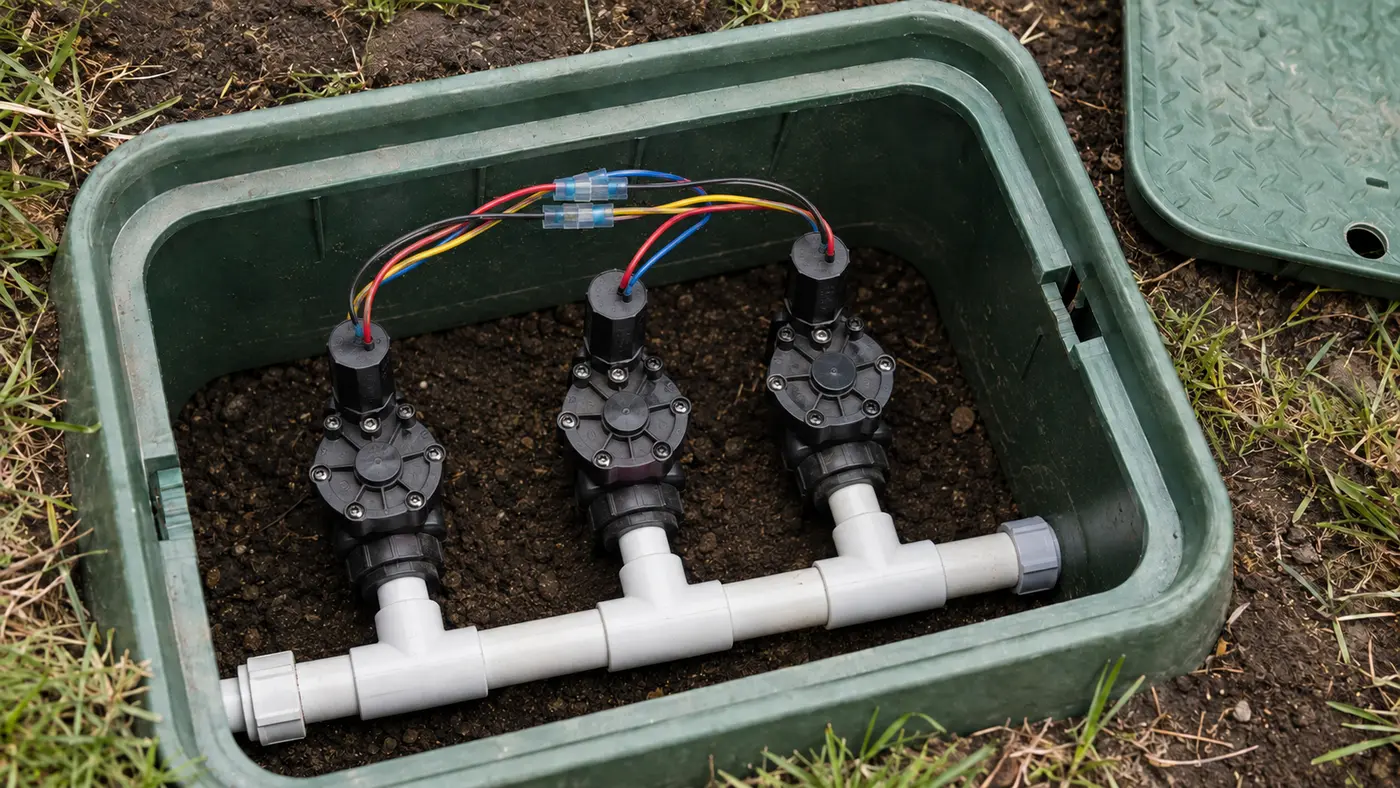
Match the pattern before opening anything
| Possible cause | Best clue | First check |
|---|---|---|
| No station run time | Manual controller test works but schedule skips | Review run time, water days, and active program |
| Failed controller terminal | The station never sends a command | Compare with a known-good station professionally |
| Open field wire or splice | No sound at the valve during an electrical run | Inspect both waterproof valve-box connections |
| Weak or failed solenoid | Manual bleed opens the valve but electrical command does not | Match and test the coil with power off |
Read the system before replacing a part
Use the observation that most closely matches your yard. Each row changes the next test, so you do not spend an afternoon proving the wrong theory.
What it meansSupply, lateral pipe, and hydraulic diaphragm path are available.
Do nextTest station output, field wire, splice, and solenoid.
What it meansThe controller issued a usable command at that point.
Do nextRepeat the measurement at the valve.
What it meansThe solenoid or valve pilot path is suspect.
Do nextIsolate the solenoid and inspect ports per the model guide.
What it meansThe field circuit works; this is program, sensor, delay, or seasonal-adjust logic.
Do nextAudit one minimal test program instead of opening the valve.
What resolved repairs add to this diagnosis
We matched 26 of the 100 reviewed outcomes to this symptom family. This is a convenience sample, not a universal failure-rate estimate, but every included case reports what restored operation.
Manual valve operation removed the lateral pipe, heads, and basic water supply from the likely list. Reported resolutions then concentrated on programming, sensor configuration, common and station conductors, splices, solenoids, and controller hardware.
Be precise about “manual”: opening the bleed screw proves hydraulics; pressing MANUAL on the controller does not. Only the first test cleanly isolates the electrical path.
A controller reset followed by reprogramming restored automatic starts.
C24 · reported resolutionA zone stopped after a contractor installed a new sprinkler headA wire locator found that the installer had cut the buried control cable; repairing that cut restored the zone.
C52 · reported resolutionNo zone would start from the controllerPushing the loose white COM conductor fully back into its controller terminal restored every zone.
C86 · reported resolutionFront zones ran in the afternoon but skipped their morning startSeparating schedule windows so the front start no longer overlapped the rear schedule's maximum run time solved the repeatable skip.
Four tests that narrow the fault
Stop as soon as one result gives you a clear boundary. The goal is not to perform every test; it is to eliminate whole groups of causes safely.
- 01
Define which 'manual' worked
Separate opening the physical valve from starting a station manually at the controller; they prove different things.
IF YES / NORMALPhysical valve only works: follow the electrical circuit.
IF NO / ABNORMALController manual works too: inspect schedule logic.
- 02
Check active terminal output
Measure station-to-COM while a manual controller run is active.
IF YES / NORMAL24–28 VAC shifts the failure to field wire, splice, or solenoid.
IF NO / ABNORMALMissing output shifts it to the terminal, module, or controller.
- 03
Check at the valve
Measure across the station and common conductors at the valve during the same run.
IF YES / NORMALCorrect voltage at the valve isolates solenoid or valve pilot path.
IF NO / ABNORMALThe field cable or splice is dropping the command.
- 04
Create one minimal schedule
Use one program, one start a few minutes ahead, today's watering day, and a two-minute run time.
IF YES / NORMALThe minimal program works; rebuild the intended schedule carefully.
IF NO / ABNORMALObserve sensor, rain delay, OFF mode, and status indicators at the expected start.
Numbers worth measuring
Measure under command, not with the station idle.
Common fixes that waste time
One proves hydraulics; the other also exercises controller output and field wiring.
That result already shows the diaphragm can pass water.
A station that also fails in controller-manual mode is not primarily a calendar problem.
How the evidence changes the repair
The homeowner said the zone 'worked manually,' but meant the valve bleed screw—not the controller's manual start.
- Manual controller start produced no click.
- The station terminal produced 26 VAC.
- Voltage disappeared across a corroded common splice in the valve box.
Clarifying the word manual prevented a scheduling detour. The physical valve test proved hydraulics; the two-point voltage test found the actual electrical boundary.
How to confirm the repair actually held
A single successful start can hide an intermittent splice, sticky valve, remaining leak, or scheduling problem. Recreate the original conditions before calling the job finished.
Pass: The valve opens without touching the bleed screw.
If not: The electrical command path is still incomplete.
Pass: Automatic mode starts and stops the same station correctly.
If not: Programming, sensor, rain delay, clock, or seasonal adjustment remains separate from the repaired hardware.
Pass: The final schedule remains predictable with no duplicate starts.
If not: The last restored setting identifies the conflict.
Check these in order
- 01
Confirm what 'manual' means
Opening the bleed screw or loosening the solenoid proves the hydraulic valve path. Running the station manually from the controller tests programming differently and does not prove the field circuit.
- 02
Run the station from the controller
Listen at the valve box. Silence narrows the problem to controller output, field wire, splice, or solenoid. A clear click shifts attention back to the valve's internal ports and diaphragm.
- 03
Inspect the terminal and splices
Turn controller power off. Reseat the station wire and inspect the two valve-box connectors for moisture, corrosion, or loose copper. Use connectors rated for direct-burial irrigation wiring.
- 04
Check the exact controller program
Verify that the station has a nonzero run time in the active program and that rain delay, sensor status, seasonal adjustment, and watering-day rules are not suppressing the automatic cycle.
- 05
Test voltage only if qualified
Irrigation solenoids commonly use a 24 VAC signal, but live electrical testing should be performed by a trained person. A good reading at the controller but not at the valve indicates a field-wire problem.
- Live-voltage testing is required and you are not trained for it.
- The field cable appears open underground.
- The controller output is intermittent or heat-damaged.
What homeowners ask about this symptom
Does manual operation prove the solenoid is good?
No. Opening a bleed screw bypasses the electrical coil. It proves that water can pass through the valve, but the solenoid, wiring, splice, or controller output can still be faulty.
Should I replace the valve first?
Not when the zone waters normally from the manual bleed. Check programming and the complete electrical path before disturbing a hydraulically functional valve.
Sources and review notes
General maintenance logic is checked against EPA WaterSense outdoor irrigation guidance. Product controls and disassembly steps vary by model; use the current manufacturer manual for your exact valve, controller, or sprinkler head.
Published and last reviewed: August 30, 2026