Visible cracking, continuous leakage under steady conditions, a relief port that keeps discharging, loss of downstream pressure, or a failed certified test can indicate a problem. A brief spit during startup or shutdown does not by itself prove failure. Identify the device, note exactly where and when water appears, isolate irrigation safely, and use a certified tester where required.
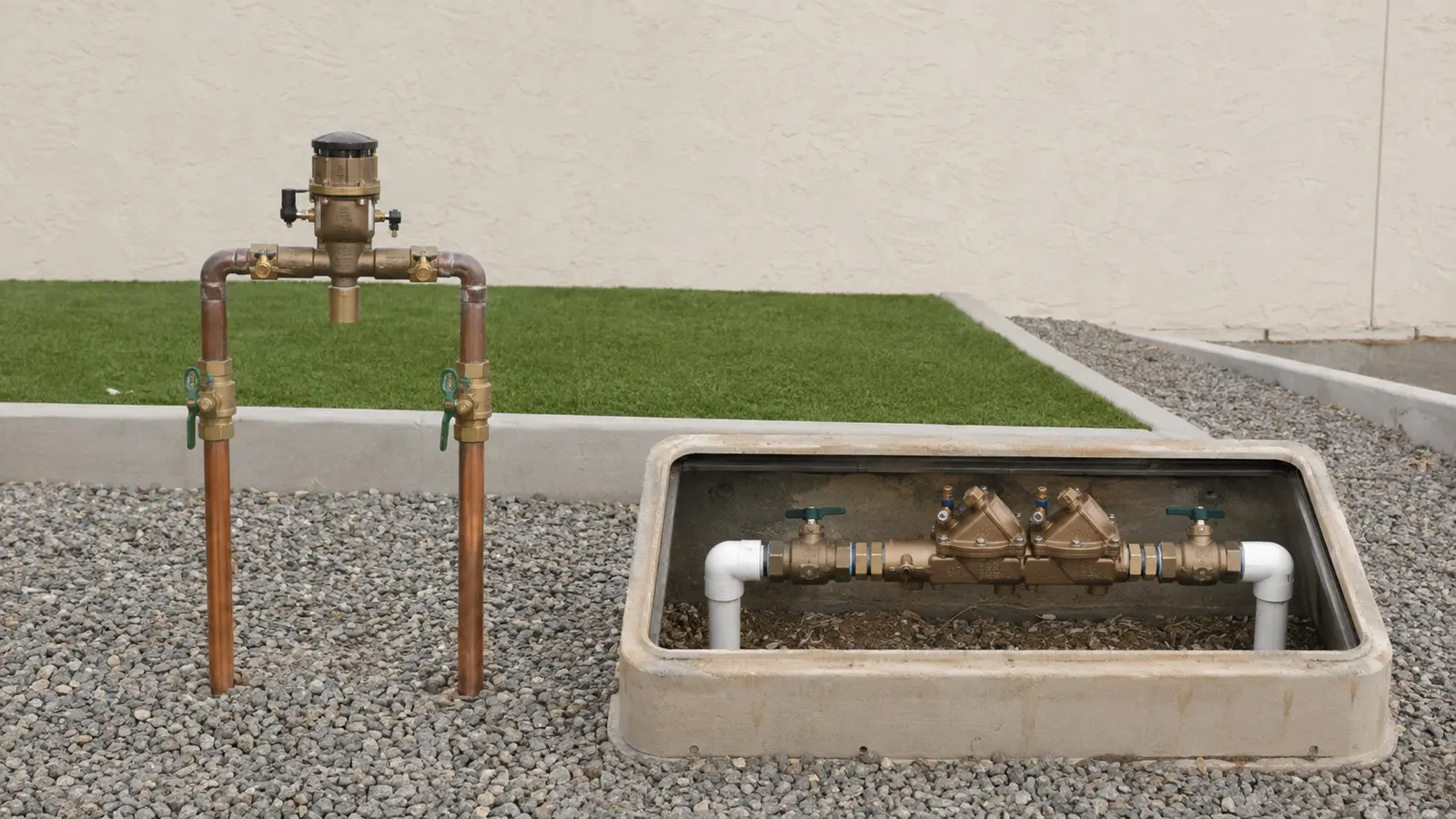
A wet backflow assembly is not one diagnosis
Dry the device, identify it, and record the first outlet plus operating state. Water running over brass often makes the lowest part look guilty.
| Observed symptom | What it may mean | Correct boundary |
|---|---|---|
| Brief PVB spit during pressure change | Transient air-inlet response or debris | Retest under steady pressure; monitor/inspect |
| Continuous PVB bonnet flow | Fouled/damaged poppet or pressure issue | Isolate and use model-specific service |
| Continuous RPZ relief discharge | Check/relief fault or pressure relationship | Keep outlet open; certified diagnosis |
| Visible casting crack/spray | Freeze or mechanical damage | Close irrigation supply; replace approved part/device |
| No visible symptom; failed test | Internal protection failure | Certified report controls the repair |
Use this boundary: One weak zone alone is poor evidence against a shared backflow assembly; compare at least two unrelated zones.
The same water discharge means different things on PVB and RPZ hardware
Identify the assembly first, then record the exact outlet and operating state. A safety discharge path must never be treated like an ordinary threaded leak.
| Observed condition | Documented boundary | Safe response |
|---|---|---|
| Continuous RPZ relief discharge | Watts treats continuous discharge as a flood-risk condition worth detecting | Keep the outlet open, protect the area, and arrange certified diagnosis |
| Intermittent RPZ relief event | An RPZ relief zone responds to pressure relationships between two checks | Record timing and pressure transitions; discharge alone does not identify the failed internal part |
| PVB bonnet/air-opening leak | A PVB has one check and an atmospheric air opening and protects against backsiphonage only | Use the exact model service path; do not diagnose it as an RPZ |
| Visible freeze split or spray | Watts and FEBCO offer freeze sensing/relief features because freezing can damage exposed assemblies | Close the private irrigation supply and replace approved pressure-rated parts |
| No leak, but failed certified test | Municipal programs require testing after installation/repair and on local intervals | The test result—not appearance—controls return to service |
| Only one weak zone | A central assembly is shared by all downstream zones | Compare a second unrelated zone before condemning the backflow assembly |
What the sample changes: Never cap an RPZ relief outlet or open test cocks as a homeowner diagnostic. Outlet, timing, device family, and a certified differential-pressure test define the repair.
Manufacturer and municipal cross-connection references were reviewed August 30, 2026. The one-zone comparison is a site-authored shared-path inference; local testing and repair rules take precedence.Match the pattern before opening anything
| Possible cause | Best clue | First check |
|---|---|---|
| Freeze-split body or fitting | Crack or spray begins as soon as supply pressure returns | Close the dedicated irrigation supply |
| Debris or worn internal seal | Leak continues from bonnet or relief area | Record the exact outlet and operating state |
| Upstream pressure event | Brief discharge occurs during a pressure transition | Time whether it stops after pressure stabilizes |
| Failed check performance | External appearance seems normal but certified test fails | Use the test report and exact model kit |
Read the system before replacing a part
Use the observation that most closely matches your yard. Each row changes the next test, so you do not spend an afternoon proving the wrong theory.
What it meansFreeze or mechanical damage has compromised the body or fitting.
Do nextClose the dedicated irrigation supply and do not patch a pressure-rated casting.
What it meansThe air inlet may be responding to a transient rather than continuously failing.
Do nextTime the event and check whether steady pressure remains dry.
What it meansA check, relief valve, debris, or pressure relationship needs certified diagnosis.
Do nextKeep discharge unobstructed and arrange testing.
What it meansA partially closed isolation valve, restriction, or device fault may limit the shared supply.
Do nextCompare inlet and downstream conditions professionally.
Four tests that narrow the fault
Stop as soon as one result gives you a clear boundary. The goal is not to perform every test; it is to eliminate whole groups of causes safely.
- 01
Dry and mark the first outlet
Dry the device, restore normal steady conditions, and observe the first bead at joint, stem, bonnet, test cock, relief port, or casting.
IF YES / NORMALThe leak point is unambiguous.
IF NO / ABNORMALWater migrating across brass can falsely accuse the lowest component.
- 02
Time the operating state
Record whether flow occurs at startup, shutdown, during zone operation, or continuously with all zones off.
IF YES / NORMALA repeatable state creates a diagnostic boundary.
IF NO / ABNORMALRandom wetness needs controlled retesting or rain/groundwater exclusion.
- 03
Check system-wide effect
Compare two unrelated zones without adjusting the assembly.
IF YES / NORMALBoth weak suggests a shared inlet restriction; one weak sends the search downstream.
IF NO / ABNORMALDo not replace the assembly for a one-zone fault.
- 04
Obtain the required pressure test
A certified tester measures check and relief performance using the exact procedure and local reporting rules.
IF YES / NORMALA passed test separates nuisance external leakage from failed protection.
IF NO / ABNORMALRepair or replacement follows the device model and failed component.
Common fixes that waste time
The discharge path is a safety function, not a drain to cap.
A pressure-rated potable-water protection assembly needs approved parts and testing.
A shared restriction normally affects more than one downstream station.
How the evidence changes the repair
A PVB left a wet mark after every morning start and was assumed to be cracked.
- No casting crack or threaded leak appeared under steady pressure.
- A short spit came from the bonnet only during initial pressurization.
- The event stopped within seconds and both test results passed.
Outlet, timing, and certified performance did not support body replacement. The brief transient needed monitoring and system-specific review, not an automatic new assembly.
How to confirm the repair actually held
A single successful start can hide an intermittent splice, sticky valve, remaining leak, or scheduling problem. Recreate the original conditions before calling the job finished.
Pass: The original leak or pressure symptom no longer occurs.
If not: The repaired part was not the complete fault.
Pass: No continuous external leak or unsafe discharge appears.
If not: Record the exact outlet and arrange retesting.
Pass: The assembly passes and any report is filed.
If not: Protection remains unverified.
Check these in order
- 01
Identify the device first
A PVB bonnet, RPZ relief valve, and DCVA test cock do not mean the same thing. Record the model before interpreting the leak point.
- 02
Mark the first water outlet
Dry the assembly and observe whether water begins at a threaded joint, shutoff stem, bonnet, test cock, relief opening, or a cracked casting.
- 03
Separate transient from continuous flow
Note whether discharge happens only during startup or shutdown and stops, or continues after pressure stabilizes. Duration changes the diagnosis.
- 04
Compare downstream performance
If every zone is weak, the assembly or upstream supply may be restricting flow. One weak zone points elsewhere.
- 05
Use a certified test as the final boundary
Backflow protection can fail internally without an obvious external leak. Where testing is required, the recorded pressure test—not visual confidence—decides service.
- The assembly is cracked, continuously discharging, or cannot be isolated.
- Local rules require a certified backflow tester.
- The device protects a potable-water connection and internal service is needed.
What homeowners ask about this symptom
Why is water coming from my backflow preventer?
Possible causes include a pressure transition, debris, worn seals, freeze damage, or an RPZ relief response. The exact device, outlet, timing, and test result determine which explanation fits.
Can a bad backflow preventer cause low sprinkler pressure?
A restriction or partially open shutoff in the shared inlet path can weaken every zone. Low pressure in only one zone is more likely downstream of its zone valve.
Sources and review notes
General maintenance logic is checked against EPA WaterSense outdoor irrigation guidance. Product controls and disassembly steps vary by model; use the current manufacturer manual for your exact valve, controller, or sprinkler head.