Start at the irrigation backflow assembly or where the irrigation line branches from the home's water supply. Check nearby green utility boxes, the meter area, basement or crawlspace entry, and the foundation wall. Do not trust box color alone: run one zone, close only the suspected valve gently, and confirm that sprinkler flow stops while house faucets still work.
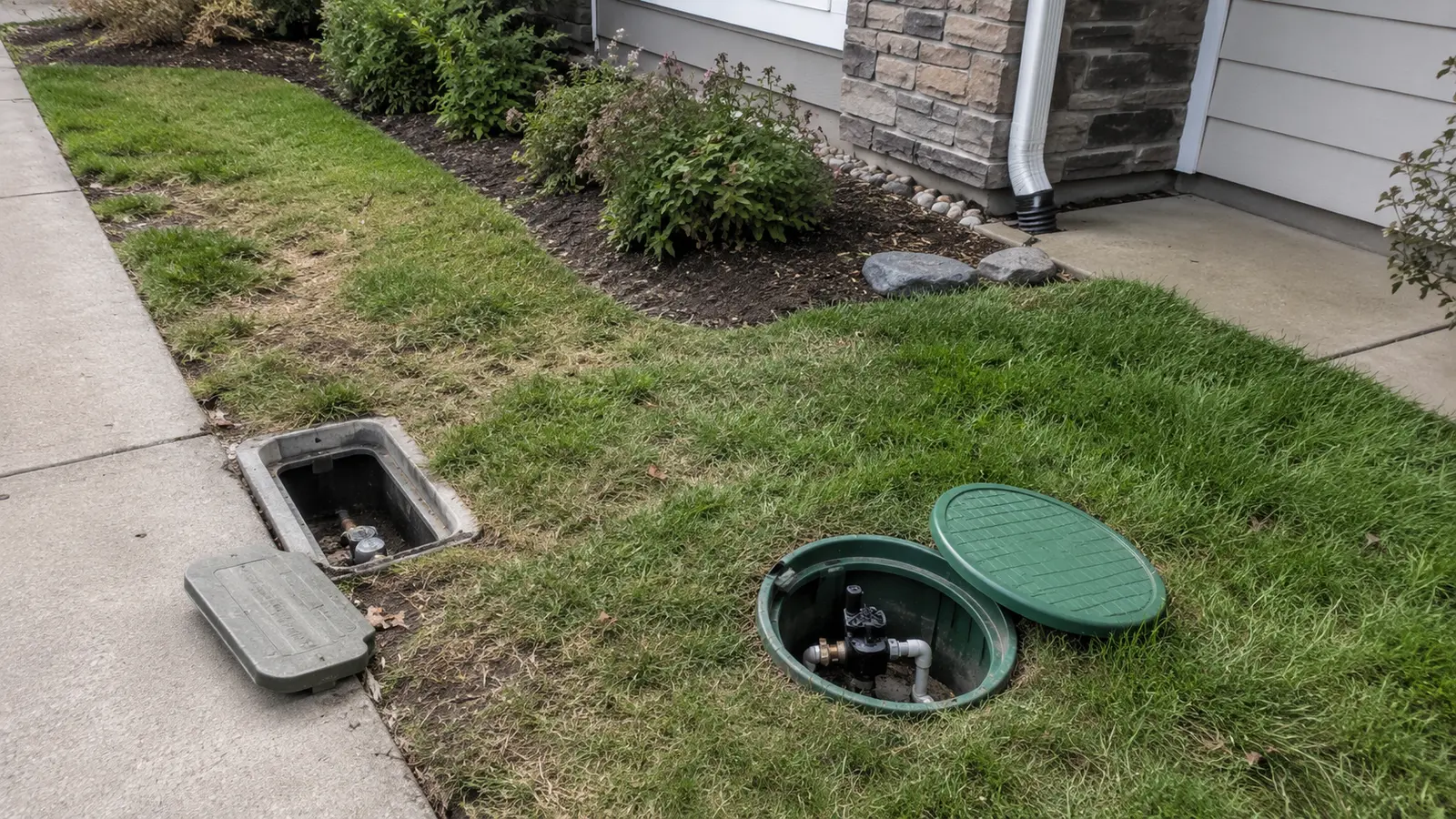
Search from a known irrigation component
Installation practice varies, but the supply path still has a direction. Start at a manifold or backflow assembly and trace toward the building or meter.
| Property pattern | Likely search area | Proof |
|---|---|---|
| Cold-climate basement/crawlspace | Near irrigation pipe foundation penetration | Sprinklers stop; domestic faucet remains on |
| Warm-climate slab/exterior plumbing | Exterior wall, meter branch, green/round box | Pipe direction leads to backflow/manifold |
| Above-ground PVB/RPZ | Upstream side of assembly or nearby interior branch | Candidate isolates irrigation without operating test cocks |
| Pump/well-fed irrigation | Pump discharge or irrigation branch manifold | Pump/system documentation confirms isolation point |
Use this boundary: Do not operate utility-owned curb stops, meter hardware, test cocks, or a seized unidentified valve.
Search patterns change with the water source and local ownership line
There is no national rule that every irrigation shutoff sits in a green box beside the meter. Use these municipal examples to choose a search path without treating local hardware as universal.
| Documented pattern | Likely location | Ownership/safety clue |
|---|---|---|
| Horseshoe Bay, Texas potable branch | Round cutoff box before the square backflow box, often near the meter | A dedicated cutoff can stop irrigation while house water remains on |
| Fort Worth irrigation requirement | Isolation valve between the water meter and backflow assembly | Trace the inlet side of the backflow toward the meter |
| Saratoga Springs secondary water | Green irrigation box at the property line near the sidewalk | Connection and seasonal position follow the city secondary-water program |
| Spanish Fork pressurized irrigation | Green/pink rectangular box or labeled metal lid along frontage/property line | The drinking-water valve may instead be inside near the line entering the home |
| Fort Lupton / Heber utility boundary | A private shutoff belongs in the owner-side control box or outside the city service box | Do not operate utility-owned valves when the city restricts access |
| Nevada meter isolation test | Close the known irrigation valve and recheck meter flow | If meter movement stops, the candidate has functionally isolated irrigation |
What the sample changes: Trace pipe direction from a known backflow assembly or manifold, then prove the candidate by stopping one active zone while a domestic faucet remains available. Color and proximity are clues, not proof.
Municipal guidance from multiple U.S. installation patterns was reviewed August 30, 2026. These examples are deliberately not merged into one claimed national standard; property records and the local utility control access.Match the pattern before opening anything
| Possible cause | Best clue | First check |
|---|---|---|
| Dedicated valve near the meter | A second branch leaves the service line toward the yard | Inspect nearby smaller green boxes |
| Indoor branch shutoff | Irrigation pipe exits a basement or crawlspace wall | Trace the pipe backward from that penetration |
| Valve beside the backflow assembly | Exposed irrigation protection hardware is visible | Follow the inlet side toward the supply |
| Buried or concealed box | Records show a valve but grass covers the area | Probe gently around the documented route |
Read the system before replacing a part
Use the observation that most closely matches your yard. Each row changes the next test, so you do not spend an afternoon proving the wrong theory.
What it meansIt is a plausible branch location, but lid color does not prove ownership or purpose.
Do nextInspect the pipe direction and compare with irrigation hardware.
What it meansThe dedicated shutoff may be inside near that penetration.
Do nextTrace the same pipe backward in the basement or crawlspace.
What it meansIts inlet leads toward the supply and often passes an irrigation isolation valve.
Do nextFollow the inlet without operating test cocks or relief parts.
What it meansThe valve has passed the functional identification test.
Do nextReopen slowly, label it, and record the normal position.
Four tests that narrow the fault
Stop as soon as one result gives you a clear boundary. The goal is not to perform every test; it is to eliminate whole groups of causes safely.
- 01
Trace upstream from a known component
Start at a valve manifold or backflow assembly and follow the inlet direction toward the meter or building.
IF YES / NORMALA dedicated branch and candidate isolation valve become visible.
IF NO / ABNORMALUse records and the four search zones before probing.
- 02
Inspect likely boxes without turning controls
Remove only safe homeowner-access lids and photograph pipe count, direction, valve type, and nearby landmarks.
IF YES / NORMALOne box contains a plausible irrigation branch valve.
IF NO / ABNORMALDo not operate utility-owned meter hardware or unidentified curb stops.
- 03
Run a controlled one-zone proof
Run one zone briefly, close the candidate gently, and observe sprinkler flow and one house faucet.
IF YES / NORMALSprinklers stop while domestic water remains, confirming the irrigation shutoff.
IF NO / ABNORMALIf both stop, you found the house main; if neither stops, restore position and keep tracing.
- 04
Confirm reopening and leak-free operation
Return the valve slowly to its original position and inspect stem, body, and nearby fittings.
IF YES / NORMALThe zone resumes and the valve remains dry.
IF NO / ABNORMALA seized or leaking control needs professional replacement before an emergency.
Common fixes that waste time
Meter, telecom, drainage, and irrigation boxes can share colors and locations.
It stops scheduled commands but does not isolate pressurized water.
A brittle valve can turn a search into an active mainline leak.
How the evidence changes the repair
A homeowner found two boxes within six feet of the curbside meter and assumed the smaller one was the sprinkler shutoff.
- The smaller box contained communications cable, not pipe.
- Tracing the backflow inlet led toward a grass-covered round box closer to the house.
- Closing that ball valve stopped an active sprinkler zone while the kitchen faucet stayed on.
Pipe continuity and a controlled functional test proved the valve. Box size, lid color, and proximity alone would have identified the wrong utility.
How to confirm the repair actually held
A single successful start can hide an intermittent splice, sticky valve, remaining leak, or scheduling problem. Recreate the original conditions before calling the job finished.
Pass: Sprinklers stop while domestic water remains available.
If not: The valve is not the dedicated irrigation isolation point.
Pass: Flow returns and no stem or body leak appears.
If not: The valve needs service before it can be trusted in an emergency.
Pass: Another person can find and identify it without guessing.
If not: Add a durable tag and wider landmark photo.
Check these in order
- 01
Start from known irrigation hardware
Identify a controller, valve box, backflow assembly, or exposed irrigation pipe. Work upstream toward the water source instead of opening random utility boxes.
- 02
Search the four common areas
Check near the water meter, foundation penetration, backflow assembly, and the line between meter and house. Regional plumbing practices differ, so use these as search zones, not guarantees.
- 03
Classify the valve before moving it
A ball-valve handle is generally parallel with the pipe when open and perpendicular when closed, but gate valves and curb stops behave differently. Never force a corroded or unfamiliar control.
- 04
Prove the candidate with one running zone
Run a zone briefly, close the suspected irrigation valve gently, and watch whether sprinkler flow stops while a house faucet remains available. Reopen slowly after the test.
- 05
Label and document it
Photograph the valve, nearby landmarks, normal operating position, and any required tool. A correct identification is worth more than a green lid that disappears under turf next season.
- The only candidate is a utility-owned curb stop or meter valve.
- The handle is seized, corroded, broken, or starts leaking when touched.
- You cannot separate irrigation water from the home's main supply.
What homeowners ask about this symptom
Is the sprinkler shutoff always next to the water meter?
No. It may be near the meter, inside the house, at a foundation penetration, or beside the backflow assembly. Installation practice varies by region and property.
Can I shut sprinklers off at the backflow preventer?
Some assemblies have isolation valves, but local rules and device condition matter. A dedicated upstream irrigation shutoff is preferable for service when one exists.
Sources and review notes
General maintenance logic is checked against EPA WaterSense outdoor irrigation guidance. Product controls and disassembly steps vary by model; use the current manufacturer manual for your exact valve, controller, or sprinkler head.