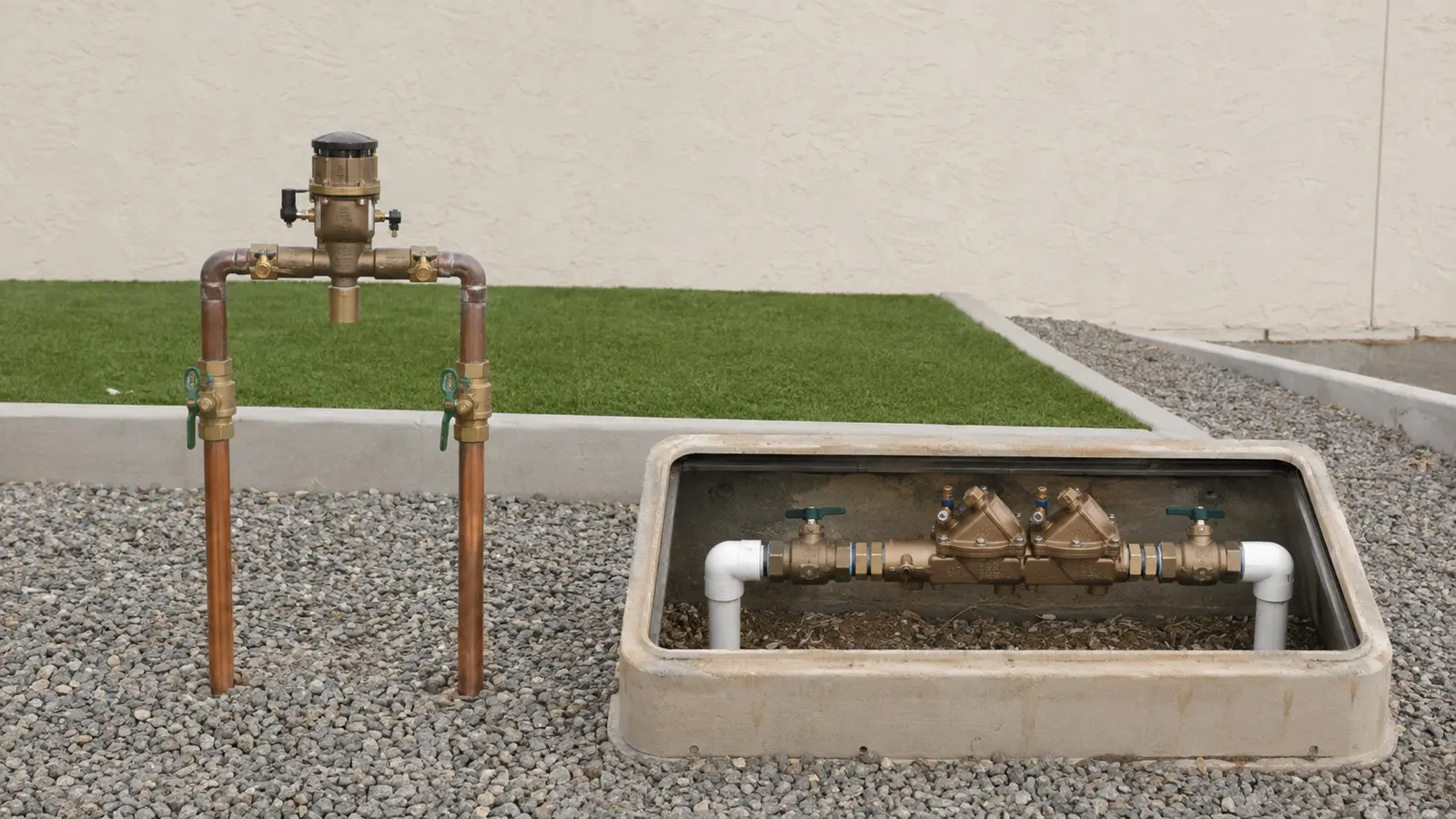
A PVB is commonly above ground and has an air-inlet bonnet on top; a DCVA usually has two check modules in a horizontal body and may be in a vault; an RPZ also has two checks but adds a visible relief-valve section that can discharge; anti-siphon valves combine zone control and atmospheric protection and must sit above downstream outlets. Local approval and installation rules decide what is acceptable—not appearance alone.
Identify function before touching a control
Use the whole installation: body sections, air inlet or relief opening, test cocks, elevation, and model tag.
| Device | Strong visible clues | Do not confuse with |
|---|---|---|
| PVB | Elevated body; air-inlet bonnet; shutoffs and test cocks | A central RPZ or an anti-siphon zone valve |
| DCVA | Two independently testable check sections in line | A small non-testable dual check |
| RPZ/RPBA | Two checks plus a relief/discharge section | A DCVA with no relief function |
| Anti-siphon valve | Zone valve combined with atmospheric bonnet above outlets | One central assembly serving every zone |
| AVB | Atmospheric inlet device with no downstream continuous pressure | PVB approved for continuous pressure |
Use this boundary: Appearance narrows the family; the cast model and local cross-connection program confirm approval and testing requirements.
Compare the mystery device with a known product family
Body shape narrows the answer; a cast model number confirms it. These examples give you a reference point without pretending every approved assembly looks identical.
| Known family example | Visible functional clue | Protection boundary |
|---|---|---|
| Watts 800M4QT — PVB | Elevated air-inlet bonnet, two shutoffs, test cocks | Backsiphonage protection; not backpressure |
| Watts LF007 — DCVA | Two independently testable checks in line, no relief discharge section | Backsiphonage and backpressure at non-health hazards |
| Watts LF009 / FEBCO 825Y — RPZ | Two checks plus a relief zone with an open discharge path | High-hazard backsiphonage and backpressure protection |
| Rain Bird ASVF — anti-siphon zone valve | Zone valve and atmospheric bonnet combined above ground | One zone; must remain above downstream outlets |
| Atmospheric vacuum breaker — AVB | Single atmospheric vent downstream of the last control valve | No continuous pressure and no backpressure protection |
What the sample changes: Count functional sections first, then confirm the cast model. Test cocks alone do not distinguish a PVB from a DCVA or RPZ.
Product families and protection boundaries were cross-checked against manufacturer pages and municipal cross-connection guidance on August 30, 2026. Local approval still controls the final answer.Match the pattern before opening anything
| Possible cause | Best clue | First check |
|---|---|---|
| Pressure vacuum breaker (PVB) | Above-ground body with air-inlet bonnet and test cocks | Record model and height above the irrigated area |
| Double check valve assembly (DCVA) | Two check sections in line, often in a box or vault | Look for two shutoffs and test ports |
| Reduced-pressure assembly (RPZ/RPBA) | Two checks plus a relief section or discharge opening | Keep the relief area unobstructed |
| Anti-siphon zone valves | Each zone valve has a raised atmospheric bonnet | Confirm every protected outlet is lower |
Read the system before replacing a part
Use the observation that most closely matches your yard. Each row changes the next test, so you do not spend an afternoon proving the wrong theory.
What it meansThis resembles a pressure vacuum breaker.
Do nextRecord height, test cocks, shutoffs, and model tag.
What it meansThis resembles a testable double-check valve assembly.
Do nextConfirm local approval and exact model.
What it meansThis resembles an RPZ/RPBA.
Do nextKeep the discharge area unobstructed and use a certified tester.
What it meansThese are likely anti-siphon valves rather than one central assembly.
Do nextConfirm their required elevation above downstream outlets.
Four tests that narrow the fault
Stop as soon as one result gives you a clear boundary. The goal is not to perform every test; it is to eliminate whole groups of causes safely.
- 01
Capture the complete pipe path
Photograph both shutoffs, inlet and outlet, test ports, body sections, elevation, and nearby ground level.
IF YES / NORMALThe functional layout can be compared with a device family.
IF NO / ABNORMALA tight crop of one brass cap is not enough to identify an assembly.
- 02
Count checks, air inlet, and relief features
Without operating anything, note an atmospheric bonnet, two check housings, or a relief-valve opening.
IF YES / NORMALThe visible function narrows PVB, DCVA, RPZ, or anti-siphon.
IF NO / ABNORMALUse the cast model and manufacturer cut sheet.
- 03
Compare elevation and installation
Measure device height relative to grade and the highest downstream outlet where relevant.
IF YES / NORMALThe arrangement is consistent with the identified family.
IF NO / ABNORMALAn incorrect installation still requires local authority review, not a DIY relocation.
- 04
Verify the model with the water authority
Provide the manufacturer, model, size, installation photo, and property use to the local cross-connection program.
IF YES / NORMALThe device type and testing requirement are confirmed.
IF NO / ABNORMALUse a licensed backflow professional before repair or replacement.
Numbers worth measuring
Local rules and highest downstream outlet requirements may be more restrictive.
Below-grade installation is allowed only where the local authority accepts the device and vault arrangement.
Common fixes that waste time
The relief section is a defining functional clue; two shutoffs alone prove nothing.
Names sound similar, but approval, test ports, and protection level differ.
Identification does not require changing a potable-water protection assembly.
How the evidence changes the repair
A below-grade brass assembly was described in a quote as a PVB because it had two small test ports.
- The body contained two horizontal check modules.
- There was no elevated atmospheric bonnet.
- Its cast model matched a DCVA accepted by the local program.
Test ports were not unique to a PVB. Body sections, elevation, and the model listing produced the correct identification and the correct testing path.
How to confirm the repair actually held
A single successful start can hide an intermittent splice, sticky valve, remaining leak, or scheduling problem. Recreate the original conditions before calling the job finished.
Pass: Body layout and listed device family agree.
If not: Do not rely on visual similarity alone.
Pass: The water authority recognizes the installed assembly and process.
If not: A licensed tester must resolve compliance.
Pass: Inlet, outlet, height, shutoffs, ports, and relief area are visible.
If not: The record is too narrow for future service.
Check these in order
- 01
Photograph the whole installation
Capture the inlet and outlet pipes, shutoffs, test ports, body shape, installation height, and nearby valve boxes before zooming in on a nameplate.
- 02
Count functional sections
One air-inlet bonnet suggests a vacuum-breaker family; two in-line check bodies suggest a DCVA; two checks plus a relief section suggests an RPZ.
- 03
Use location as a clue, not proof
PVBs are commonly elevated; DCVAs may be below grade where locally permitted; RPZ discharge must be considered. A noncompliant installation can still look familiar.
- 04
Record the exact listing and model
Use cast markings or a tag to find the manufacturer's current manual and approved repair kit. Similar brass bodies can have different service requirements.
- 05
Confirm with the local water authority
Accepted device types, testing intervals, installer licensing, and reporting rules vary. The local cross-connection program is authoritative.
- The device is leaking, frozen, damaged, or discharging continuously.
- Testing, internal service, relocation, or replacement is required.
- You cannot identify whether the assembly protects potable water.
What homeowners ask about this symptom
Is a check valve the same as a backflow preventer?
No. An approved backflow assembly has a defined protection level, testability, installation requirements, and listing. A single check valve is not automatically an acceptable irrigation backflow device.
Why does identification matter before repair?
PVB, DCVA, RPZ, and anti-siphon devices protect against different hydraulic conditions and have different installation, drainage, testing, and legal requirements.
Sources and review notes
General maintenance logic is checked against EPA WaterSense outdoor irrigation guidance. Product controls and disassembly steps vary by model; use the current manufacturer manual for your exact valve, controller, or sprinkler head.
Published and last reviewed: August 30, 2026