Do not turn every zone on at once. With the controller off, inspect exposed plumbing, open the irrigation supply slowly, and pause before running any station. Water that appears before a zone starts is on the pressurized side; water that appears only during one zone belongs to that zone's valve outlet, lateral pipe, fittings, or heads.
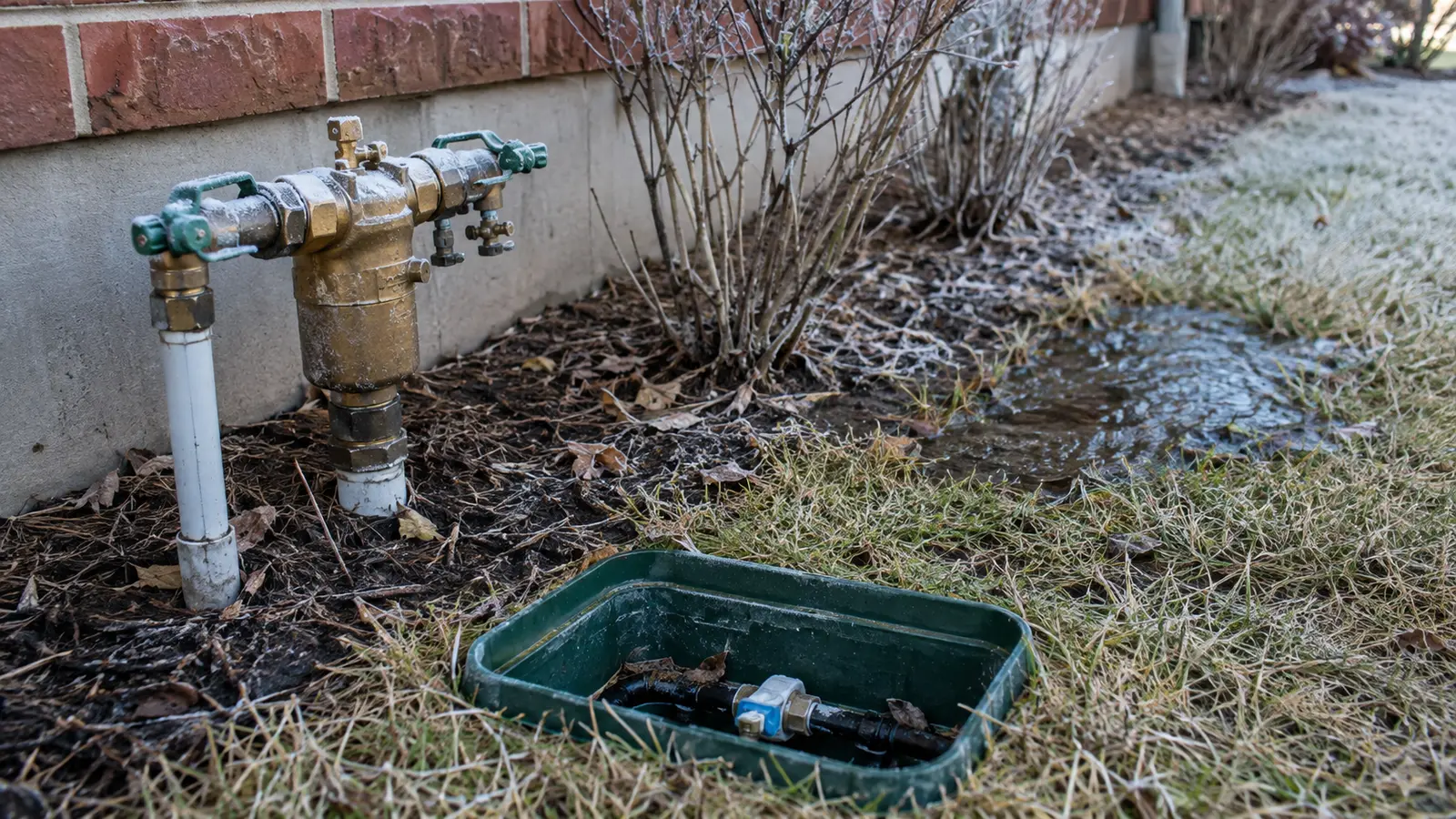
Match the pattern before opening anything
| Possible cause | Best clue | First check |
|---|---|---|
| Cracked exposed backflow or fitting | Water appears as soon as the irrigation supply is opened | Keep all zones off and watch every exposed joint |
| Split mainline or manifold | Meter movement or pooling begins before a station runs | Close the irrigation shutoff and trace the first wet point |
| Broken lateral pipe or head | Leak begins only when one zone is active | Run that zone briefly and map normal-to-weak heads |
| Controller or sensor still in winter mode | No physical leak, but schedules do not start | Test one station manually before changing programs |
Read the system before replacing a part
Use the observation that most closely matches your yard. Each row changes the next test, so you do not spend an afternoon proving the wrong theory.
What it meansThe leak is on the continuously pressurized path, manifold inlet, or a valve that cannot seal.
Do nextClose the irrigation supply and inspect exposed hardware and the first filling valve box.
What it meansThe failed boundary is downstream of that zone valve.
Do nextMap the last normal head, first weak head, and first bubbling soil.
What it meansA partly reopened shutoff, shared supply restriction, master valve, or hidden mainline loss is more likely.
Do nextVerify the common water path before opening individual valves.
What it meansA cracked body, riser, swing joint, or nearby fitting is local to that outlet.
Do nextShut the zone off and expose only enough to identify the broken component.
Four tests that narrow the fault
Stop as soon as one result gives you a clear boundary. The goal is not to perform every test; it is to eliminate whole groups of causes safely.
- 01
Create a dry, zero-pressure baseline
With the dedicated irrigation supply off and controller inactive, dry exposed fittings and photograph valve boxes.
IF YES / NORMALA stable baseline makes new water traceable.
IF NO / ABNORMALWater already returning may be groundwater, drainage, or a non-irrigation source.
- 02
Pressurize without opening a zone
Slowly open the known irrigation shutoff and pause with every station off.
IF YES / NORMALNo leak after the observation period permits short zone tests.
IF NO / ABNORMALImmediate water identifies a pressurized-side or non-closing-valve fault; shut water off.
- 03
Run isolated one-minute zone tests
Start one station, walk its heads and pipe path, stop it, then let the surface settle before the next zone.
IF YES / NORMALNormal rise, throw, and dry soil clear that zone provisionally.
IF NO / ABNORMALA zone-specific wet or weak pattern defines the downstream search area.
- 04
Use the meter only under controlled conditions
Turn off indoor water uses and compare the meter with irrigation supply closed, then open with zones off.
IF YES / NORMALNo irrigation-side movement supports a sealed pressurized path.
IF NO / ABNORMALMovement that stops when irrigation is isolated supports a hidden irrigation leak.
Numbers worth measuring
This timing is more useful than puddle size because it assigns the leak to a specific downstream circuit.
Common fixes that waste time
Water migrates through soil and erases the first-source clue.
A cracked lateral fitting can surface beside an intact head.
A closed shutoff, valve restriction, clogged screen, or overload can produce the same symptom.
How the evidence changes the repair
After a hard freeze, four far-end heads on Zone 5 stayed down and a valve box looked dry.
- No water appeared while every station was off.
- The wet patch began only 40 seconds after Zone 5 started.
- The last two normal heads were uphill of the first bubbling point.
The off-state check cleared the mainline and exposed assembly. Zone timing plus the normal-to-weak boundary narrowed the search to one lateral segment, avoiding excavation at the valve box.
How to confirm the repair actually held
A single successful start can hide an intermittent splice, sticky valve, remaining leak, or scheduling problem. Recreate the original conditions before calling the job finished.
Pass: No exposed joint, box, soil patch, or meter indicates continuing flow.
If not: A pressurized-side leak or non-closing valve remains.
Pass: All heads rise normally and the original wet boundary stays dry.
If not: A second crack or restriction remains downstream.
Pass: The repair holds under normal duration and valve closure.
If not: Longer operation reveals a leak missed by the short test.
Check these in order
- 01
Inspect before adding pressure
Look for split brass or plastic, pushed-out caps, displaced test-cock parts, cracked valve bonnets, and heaved heads. Photograph anything suspicious before moving a handle.
- 02
Pressurize with every station off
Open only the known irrigation isolation valve, and open it slowly. Stop immediately if an exposed component sprays or a valve box starts filling. This phase tests the continuously pressurized side.
- 03
Run one zone at a time
Start with a short one-minute test. Flag the first bubbling soil, the last normal head, and the first weak head. Shut the zone down before runoff hides the origin.
- 04
Classify the leak by timing
A leak present with all zones off belongs upstream of the zone valve or to a valve that will not seal. A leak that begins only with one station active is downstream on that zone.
- 05
Verify after the repair
Repeat the same off-state observation and the same short zone test. A dry surface alone is not enough; confirm normal head rise and no meter movement when irrigation is idle.
- An above-ground backflow preventer, pump, or pressurized mainline is cracked.
- Water approaches a foundation, electrical equipment, roadway, or utility marking.
- The dedicated irrigation shutoff does not stop the leak.
What homeowners ask about this symptom
Can underground sprinkler pipes freeze?
Yes, especially where water remains in shallow pipe, low points, fittings, valve bodies, or exposed transitions. Damage may remain invisible until the system is pressurized.
Does low pressure after winter prove a frozen pipe cracked?
No. A partially open shutoff, clogged nozzle, valve restriction, or disconnected controller path can look similar. Leak timing and the one-zone-versus-all-zones pattern are stronger first tests.
Sources and review notes
General maintenance logic is checked against EPA WaterSense outdoor irrigation guidance. Product controls and disassembly steps vary by model; use the current manufacturer manual for your exact valve, controller, or sprinkler head.
Published and last reviewed: August 30, 2026