A wet valve box does not automatically identify the leaking part. Remove the standing water, keep all zones off, and watch where and when it returns. Water appearing continuously suggests a pressurized mainline, manifold, or external valve leak; water appearing only during one zone points toward that valve or lateral connection.
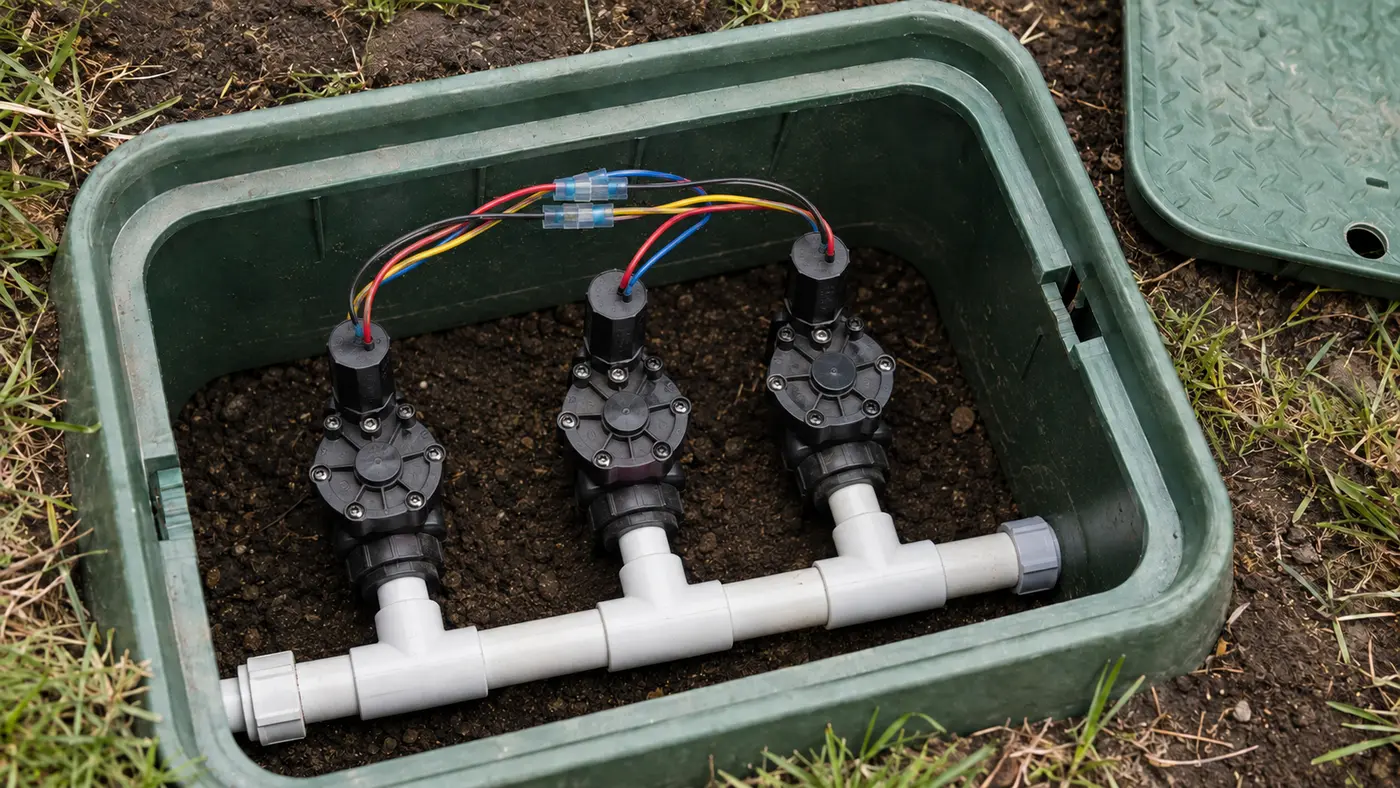
Match the pattern before opening anything
| Possible cause | Best clue | First check |
|---|---|---|
| Rain or poor drainage | Water follows storms and does not refill in dry weather | Empty the box and observe with system off |
| Pressurized mainline or manifold leak | Box refills while every zone is off | Watch upstream fittings without disturbing them |
| External valve or solenoid leak | Water beads from the bonnet, body, or coil area | Dry the component and observe the first wet point |
| Lateral connection leak | Water appears only while one zone runs | Run zones briefly one at a time |
Read the system before replacing a part
Use the observation that most closely matches your yard. Each row changes the next test, so you do not spend an afternoon proving the wrong theory.
What it meansA pressurized joint, valve body, bonnet, or downstream fitting may leak under operation.
Do nextDry the box and run zones one at a time.
What it meansGroundwater or surface drainage is entering the box.
Do nextInspect grade, lid, soil drainage, and nearby runoff.
What it meansA mainline-side leak is possible because that piping remains pressurized.
Do nextCheck the irrigation meter or isolation boundary and call a professional if flow continues.
What it meansPoor drainage may coexist with a small leak and conceal its origin.
Do nextRemove water, dry visible fittings, then observe the first wet point.
Four tests that narrow the fault
Stop as soon as one result gives you a clear boundary. The goal is not to perform every test; it is to eliminate whole groups of causes safely.
- 01
Remove water and establish a baseline
Use a hand pump or wet vacuum without pulling wires; dry visible valve surfaces and photograph them.
IF YES / NORMALThe first returning water can be traced to a component or soil edge.
IF NO / ABNORMALIf the box refills too fast to observe safely, isolate irrigation water and call a pro.
- 02
Observe with every zone off
Watch for 10–15 minutes in dry weather before running anything.
IF YES / NORMALRising clean water suggests pressurized supply leakage.
IF NO / ABNORMALA stable dry box allows controlled zone-by-zone testing.
- 03
Run zones one at a time
Start with the nearest valve and watch the bonnet, solenoid, threaded connections, and pipe entries.
IF YES / NORMALWater begins with one zone: isolate that valve or downstream connection.
IF NO / ABNORMALNo operational leak raises drainage or intermittent mainline seepage.
- 04
Use the water meter boundary
With household fixtures and irrigation commands off, observe the leak indicator only if the meter is safely accessible.
IF YES / NORMALMovement supports an active pressurized leak somewhere on the metered system.
IF NO / ABNORMALNo movement during the observation window lowers, but does not eliminate, the chance of a small intermittent leak.
Common fixes that waste time
It treats standing water without locating a pressurized leak and can invite more soil.
Bonnet, body, and threaded leaks require the correct seal or component repair.
Low voltage still deserves power-off work, and disturbing a marginal common splice can disable every zone.
How the evidence changes the repair
A valve box was full every morning despite a week without rain.
- After pumping it dry, clean water appeared first at a threaded inlet before any zone ran.
- The meter leak indicator moved with all indoor fixtures off.
- Closing the dedicated irrigation isolation valve stopped both observations.
The timing—before any zone command—separated a mainline-side leak from lateral-zone leaks and groundwater. The isolation test defined the repair boundary without guessing which solenoid was bad.
How to confirm the repair actually held
A single successful start can hide an intermittent splice, sticky valve, remaining leak, or scheduling problem. Recreate the original conditions before calling the job finished.
Pass: No clean water returns during the original observation period.
If not: A pressurized leak or groundwater source remains.
Pass: All valve and pipe joints stay dry under operation.
If not: The zone that recreates water identifies the active repair boundary.
Pass: The box drains normally and stays below the electrical splices.
If not: Surface grading or groundwater entry is separate from any repaired plumbing leak.
Check these in order
- 01
Remove water before diagnosing
Pump the box down rather than reaching blindly into muddy water. Keep electrical splices out of standing water and avoid pulling on wires or plastic manifolds.
- 02
Observe with all zones off
Dry accessible surfaces with paper towels. If water immediately returns, note the first wet fitting. Continuous refilling is more consistent with the pressurized side than with a downstream lateral.
- 03
Run one zone at a time
Use short tests and watch from a safe position. Water that begins only on a specific station narrows the source to that valve outlet, lateral adapter, or nearby pipe.
- 04
Separate groundwater from an irrigation leak
If the box fills only after rain, look at grading and drainage. If it fills during dry weather and stops when the dedicated irrigation supply is isolated, the irrigation system is the likely source.
- 05
Repair the source, not the box
Adding gravel may improve drainage but will not fix a pressurized leak. Do not bury the evidence or seal a box that needs to remain accessible for service.
- The box refills rapidly with every zone off.
- A cracked manifold, backflow device, or mainline fitting is suspected.
- Wiring is submerged, damaged, or connected with non-waterproof hardware.
What homeowners ask about this symptom
Is water in a sprinkler valve box normal after rain?
Temporary rainwater can collect in poorly drained soil, but a box that repeatedly fills in dry weather or refills after pumping likely has an irrigation or groundwater source that needs tracing.
Will adding gravel fix a flooded valve box?
Gravel can improve drainage around an otherwise sound box. It cannot repair a leaking valve, manifold, or pressurized pipe.
Sources and review notes
General maintenance logic is checked against EPA WaterSense outdoor irrigation guidance. Product controls and disassembly steps vary by model; use the current manufacturer manual for your exact valve, controller, or sprinkler head.
Published and last reviewed: August 28, 2026